
Thursday, November 01, 2007
Girl Talk Interview: Not Just A DJ
 (Photo: Moe Train on Flickr)
Music writing hyperbole often seems misplaced but when it comes to a Girl Talk show it's entirely justified. At the first leg of his North American tour with Dan Deacon nearly a month ago, Girl Talk weaved a messy mix bag of down town hipsters and fresher week college drunks into a sweltering, unified but squirming beast of jiving bodies, sending 'em ga-ga with his irreverantly mashed beats and acapella. I caught up with Girl Talk a week or two after the show and chewed the fat over crowd control, how he re-defines sampling and the politics of piracy. This interview was first published in Fact Magazine in the UK.
Can you give Irish readers some idea of what to expect from your shows and do you have any plans to make it over this side of the Atlantic any time soon?
I haven't been over to Europe much in the past year because I was holding down a day job and only doing Friday and Saturday shows. I quit that job about 3 months ago, so I'm planning on traveling world wide very soon.
My shows are highly dependent on the people who come out to them. I play a single laptop. I mix and match a bunch of samples and loops on the fly. It sounds like my records, but it's a bit more free form. I like to party every time I play. I get sweaty. I get in the crowd. I dance with people. But, it's really up to the people as to how insane we're going to get. I'm ready to take it to the distance.
People like to read into things like an artist getting fans up on stage, or playing in the crowd like Lightening Bolt or Dan Deacon even, whats your reason - is it just a better party or do you like levelling it out and reducing that 'me the artist up here, you the fan down there' buzz?
To be honest, I never made a decision to have it happen. I've been playing live as Girl Talk for seven years, and sometime last year, fans started jumping on stage. People saw video of that on the internet, and it spread. Within a few months, it became this standard for my shows. It makes sense to me now. There's only so much I can physically do on stage to entertain people. I actually have to click the mouse every 10 seconds to keep the music going.
I think the people on stage is pretty much the best visuals I could have. There are some people who just like to come out and hear me do the music live, and to them, there's also some entertaining to watch. To those people who want to come party, then there's a whole dance floor and stage for that. I'm just a dude playing a computer; I'm not Steven Tyler up there. I like people to be able to interact with me to any level that they want. I like to minimize as many pretensions as possible with the music and shows.
I caught you at the Toronto show, it was pretty hectic, I'm not sure what your other shows are like - but have you ever seen bouncers do anything particularly stupid in getting fans off the stage and has the hectic crowding around you ever interfered with your ability to perform, like knocking your laptop over and people hitting keys drunk off their face and stuff?
With my shows, it's probably a bit more work for bouncers than the normal gig, so I really respect them for putting up with any bullshit. But yeah, it can get crazy, and sometimes, people cross lines. I always talk with the security before the shows and let them know what's going to go down.
I've had tons of problems in the past people stomping on cords, equipment, hitting the computer, spilling things, not having any room to even move my arm, and so on. I don't like it when those things happen, but it comes with the turf. The shows to me oftentimes feel like house parties, and I love that. It doesn't feel like going to a standard dance club or a rock show where nothing is going to go wrong. When the music stops prematurely at my show, that's a sign that things are truly getting insane. That's cool to me. It's part of the experience. I like when the shows are just barely staying together, everything is on the verge of falling apart. That's a great party to me.
I heard you recently posed for Playgirl in the man of the year issue, how the hell was that?
They wanted a "sexy photo shoot," which I think meant nude. I ran it past my parents, and I decided to keep my pants on. I've been a lot more nude at some of my live shows this year, so it wasn't too big of a deal.
You've talked before about how being Girl Talk and an engineer by night was like leading this double life, you sort of kept it quite from your work colleagues - when you finally made the decision to quit did the people there discover your other side and how did they react?
They never officially discovered about my music world. I told them I was quitting to travel the world before I was too old to do something like that, which isn't really a lie but not the complete truth. I'm still convinced that someone there knew but chose to not call me out.
You refuse to be seen as a DJ, hence those famous "I'm not a DJ t-shirts" - so what sort of live set up do you use and how much time do you think you spend on each track, from the initial idea to its readiness to be played live or dropped onto a CD?
 (Photo: Tom Purves on Flickr)
I perform live on multiple copies of a program called Audiomulch. It allows me to cue up, mute, and manipulate a bunch of samples in real time. I perform it all live, but it's a rehearsed set. I think people get my records and come see my live to hear the compositions, rather than to hear me improvise. So I spend a lot of time on doing arrangements prior to performing.
It's tough for me to calculate how much time I put into specific tracks. I'm constantly working, and most things I sample don't see the light of day. I'm about ready to put together a new album right now, and it's been about a year and half since I finished up my last one. I've been averaging releasing a 40 minute album every 2 years. That's about as quantative as I can get.
I've heard you were in a few noise outfits before Girl Talk, when did you make the switch to party music and how does it relate to the sort of projects you were involved in before Girl Talk? I'm just wondering where the name comes from too?
I was in a noise band in high school. It definitely laid the ground work for Girl Talk. We worked with many different forms of experimental sound collage. We made music using physical tape collages, skipping CD's, and manipulated four-track machines.
I started the Girl Talk project in 2000, and I initially had a glitchy and avant-garde sound. I've always been a pop music fan; it just took me a few years to be comfortable making more accessible music. I started playing house parties around 2002, and I think this is when my music started to take more traditional form. The name Girl Talk comes from Yes lyrics.
You like to see your own compositions as original mash ups and sort of separate yourself from the whole mash up movement, are you still critical of it and why?
I just don't feel comfortable with many genre names in general. They are all silly to me. I like mash-ups. I don't want to separate myself from anything. For me, I was influenced to get into this style of music by people like John Oswald and Kid 606. I also listened to bands like Public Enemy growing up. These are all people who are sample-based at times but aren't usually labeled as "mash-up" artists. I'm down with all types of music. I just thought the label "mash up" might mislead people with my music. Maybe not, I don't really know.
One thing that interests me about Girl Talk, and I've heard a lot of people say this is that you are legitimizing listening to forms of commercial music that people would otherwise scoff at, sometimes this music is damn good but people need to hear it through an irony filter before admitting this. How do you feel about being this "cool" filter for people, do you think they should just drop their pretensions and recognize a good track when they hear it and not when its a safe "classic" years later?
I sample everything sincerely. I like all of the music I sample. There is no irony. I'm definitely not trying to act as any sort of "cool filter." I'm down with people being turned on to new forms of music in any way. I like how people have major differences in their interpretations of my
music. Some people like it because they love the source material; some people like it because they hate the source material. I've always hoped that my work is transformative. I want people to hear my songs and say "That's a Girl Talk song," rather than "That's song A mixed with song B mixed with song C."
I think the act of sampling music to make new music, and the fans of the new music not necessarily being into the original source material is not a new thing. Think about the history of hip hop. Producers will sample anything to make a hip hop beat; that doesn't mean that the people into the beat will be into or should be into the source material. Most young kids who jam Kanye West could probably care less about Chaka Khan. It's the context and the additional production that makes people get down with it.
Your congressman Mike Doyle seems to be quite taken with you, you are well aware too of the dangers you face from major labels around being sued for copyright breaches and have played a benefit for the Creative Commons project - how does it feel to be turned into something of a figure head for "free culture"/or the fair use movement? Can there be a reconciliation with existing copyright law or do we need a complete rupture with the economic mentality they base it on?
I've never pushed a political agenda with my music. I've always made music with samples because I simply enjoy it. If my music makes people think about these type of things, then that's cool to me, but it's really a side note.
Fair Use is a progressive idea with the existing copyright law, but it's very black and white to me. I think the current law doesn't taken into account an album that can be made from 300 samples that most major music sources and publications treat at as an original work.
I see your website links to Drop the Lime, who I've interviewed before, he's really one of my favourite DJ's and producers, have you been up to any of the Trouble and Bass parties he puts on and what do you think of the whole thing thats going down at the moment from "bass music" to new rave/french electro etc? Is there something in the air and people are just looking to dance?
I haven't been to any of those parties unfortunately. Luke and I go way back. We did one of our first tours together in 2003 or so, back when he was called Dysis. He seems like he's really shaking things up in New York right now, which gets me pumped.
I notice as well you mentioned elsewhere you liked Kid 606, Shitmatt and Jason Forrest, do you think the whole breakcore thing, aside from the frantic amen breaks and cut up sampling technique of it had any influence on your approach to music production?
Yeah, to a degree. I was more into the music known as IDM when I first started doing Girl Talk productions. I think the quick-paced nature of my music is influenced by guys like Aphex Twin and Squarepusher more than anything else. It seems like some breakcore artists came from this sort of background, so I think it's related.
I've always felt more connected to guys like Jason Forrest than more standard mash up artists. He's another guy who's make original music almost completely out of samples. I was reading on your blog about a remix project that you're working on called Trey Told 'Em. Could you tell me a little bit about that and what you have planned for the future?
It's a project with Frank Musarra and I. I'm dedicating all of my remix work to it. I want to concentrate on other material for Girl Talk. Frank and I are also doing beats together. We work with samples at times, but it doesn't have to be appropriation-based. We also do original instrumentation.
Labels: girl talk, Interviews, Music
(0) comments
Thursday, October 04, 2007
Interview: Going Beyond The Green Zone With Dahr Jamail
 It's a cliché that the media was the first casualty of the Iraqi occupation, but few reacted like Dahr Jamail. Made brazen by his travels off the beaten path between monotonous jobs, he packed a cheap digital camera along with a laptop and entered Iraq to go beyond the Green Zone and embedded reporting.
 The dispatches he circulated online, first through emails and then through his site, quickly grew into an essential resource for those in the west desperate for an alternative take on the war on terror. They remain today a vital channel for struggling voices inside occupied Iraq.
A collection of Dahr's work called Beyond the Green Zone: Dispatches From an Unembedded Journalist in Occupied Iraq is coming out this month on Haymarket Books, prior to its release he sat down with Indymedia Ireland to talk about his journalism and the situation in Iraq.
Tell me about the thought process that drove you into making that first trip to Iraq, the resources you had at your disposal and how you coped with such dramatically different and dangerous place?
"I followed the media coverage of the selling of the war by the Bush administration, and compared that to the UN reports and other reportage I was scanning in foreign media outlets, and knew that this war was based on lies. Watching the mainstream media in the US act as functional propagandists rather than critical journalists, I became enraged. I could barely believe my eyes, watching a war being sold to the American public, as propaganda disguised as news.
"I felt that as a US citizen the best thing I could do was go report on what I saw myself, so after the invasion took place and the occupation began, (and reporting continued to be horrible overall) I decided to head to Iraq. I had saved $2000, had a laptop and a small digital camera, and made connections with a couple of people in Baghdad via the Indymedia Beirut website. Through a Lebanese man who was in Baghdad writing about what he saw, I obtained the necessary information to get into Baghdad relatively safely.
"I had few resources and was totally independent. Luckily, I began to meet just the right people at the perfect times-which is how I met my first interpreter in Baghdad, met other foreign journalists to work with to share costs, and eventually began to get hired and paid to report.
"I had previously done a lot of international travel, so going to a new country wasn't terribly difficult for me. However, going into a war zone was different, and certainly took a lot of getting used to."
In your book you describe having the feeling that "most people seemed blissfully unaware" of what is going on in Iraq. Some of this you put down to the corporate media, in a sense I think people have a difficulty coming to terms with Iraq because it is all news-flashes lacking a wider context, then there is dis-information on the level of stabilisation and an expert led discussion on geo-politics that dissuades people from trying to get a grip. For those that want to come to terms with what is happening in Iraq, apart from your book where would you advise them to start looking?
"First I think it's important that people read about US foreign policy, particularly regarding the Middle East. Read the document the current National Security Strategy (updated 2006) is based on, the Project for the New American Century. Then read the NSS, then the Quadrennial Defense Review Report. Those lay out, quite clearly, US goals for using the military to control strategic oil/gas reserves and transportation lanes around the region.
"Then for news, read foreign media, or alternative media. Democracy Now! in the US is good, as is the Independent newspaper in the UK, Al-Jazeera Arabic television, and other good information websites like informationclearinghouse.info. Needless to say, almost all of the best resources people need for tracking what is happening in Iraq are found online. This includes various Indymedia sites around the globe as well."
You left Iraq for home just before the transfer of sovereignty, and upon your return you found "Iraq is yet another country" - that was pretty much two years ago, how different again is it now today and what is required for unembedded journalists like yourself to remain safe?
"The situation in Iraq degraded so quickly once the occupation began that each and every trip I went back it felt like a different country. I have not returned to Iraq since just after the elections of January 2005. All of the fixers/interpreters I had worked with told me to return would mean almost certain death to me, or to them. Any Iraqi working with a westerner now is seen as a collaborator or as a spy, and will likely be killed or kidnapped. Thus, I decided it would be incredibly selfish of me to return and risk the lives of any Iraqi working with me.
"My contacts there tell me it is nearly impossible to work as a western journalist without embedding with the military. I know a few westerners who have gone back recently-and they barely left their hotels. Reporting safely from Iraq now, for an Iraqi or westerner, is impossible. We're now in a position where we must rely on Iraqis to do all the reporting about what is happening in their country."
How did Iraqis view the massive anti-war movement that developed around February 15th and in the run up to the invasion and what forms of solidarity from western activists have the most value in the current context?
"Iraqis told me they were inspired by the pre-war displays of dissent in the west on that date. I was told repeatedly by Iraqis that they liked the American people, but not their government. Even well into the occupation when the country was disintegrating, Iraqis continued to make the distinction between US citizens and their government. However, a deeply troubling crisis is that that distinction is no longer being made by most Iraqis. They've seen Bush reelected in 2004, and more recently the so-called Democrats win the mid-terms in the US and do nothing but continue to fund and support the occupation. Thus, western activists have their work cut out for them."
What do you make of the internal debates in the western left about the nature of the Iraqi resistance and the recent "third camp?" I'm sure you've come across arguments about how the resistance is politically Islamic in composition, and that we should be trying to support a secularist resistance rather than homogenizing support to the resistance with no critical take?
"I think the elements of the western left who are engaged in this debate about what is or isn't the legitimate resistance in Iraq haven't a leg to stand on. What I mean by that is that it is the failure of the so-called anti-war movement, particularly in the US, to stop the war from being launched in the first place. Thus, whatever form of resistance used in Iraq, and whoever chooses to participate in it, is of no business of the so-called anti-war movement, particularly when much of that movement continues to support so-called Democrats who continue to fund the occupation.
"The Iraqi people have a legitimate right, under international law, to resist the occupation of their country. It was an illegal invasion which contravened the UN charter, and is thus by definition an illegal occupation. There are countless forms of resistance in Iraq today-political, civil, and armed, and they are all legitimate under international law."
There's an interesting section in the book where you mention mass dissent against the newly proposed Iraqi flag, with people tearing it down everywhere it was flown and driving occupation forces crazy by putting the old one on display everywhere they could. Can you tell us of some more mass acts of popular resistance to the US forces along these lines?
"Across the board Iraqis opposed the occupation. Like the flag example, this took many forms-not giving information to US soldiers about whether or not there were resistance fighters in their area, not supporting the US-backed Iraqi puppet governments (all of them), and doing what they could to report what was actually happening in their country to reporters willing to write it. These were all consistent acts of popular resistance I saw, and which continue today."
Have other forms of resistance outside of militarism arose to sea changes like privatization of the oil industry, water supply and so on?
"Yes. The oil union workers in Basra continue to play a critical role in staving off the privatization of Iraq's oil infrastructure. Without their strikes, their ability to apply political pressure, as well as their efforts to educate people in the west about what is being done to attempt to control Iraq's oil, it may well have already been privatized. The same can be said, although less obviously, regarding other aspects of Iraq's infrastructure."
With companies like Bechtel failing to restore water supplies, you describe how people in an area near Najaf collected funds to repair it themselves - is this sort of self-organised community response to the failure of the occupation a developing theme in Iraq or is it rare?
"It is common, but on a micro-scale. One thing that is difficult to impart to the west is how grave the situation in Iraq has become. As brutal as so many of the stories are in my book, it is far worse today. People there are literally in survival mode. So, for example, one person who can afford a generator in a neighborhood gets one. Then they'll run wires to all their neighbors homes to share. The same can be said of someone who can afford some cooking gas, or a doctor in the neighbourhood will treat people there in their homes, etc. Particularly in Baghdad, self-organizing communities are all that is left now, so that is how most people are getting along, and this is spreading all over Iraq as a matter of necessity and survival. It's literally band together as a community or die."
In one short section in your book you mention the strategies people have come up with to over-come unemployment, things like re-selling petrol to those sick of waiting in station queues and the like – could you tell us some more about the toil of unemployment in Iraq and how people are faring in this new informal labour economy?
"Some of this I've mentioned-doctors are treating neighbors and friends who can't leave their neighborhoods because of the security situation. Engineers are running electrical wires through their communities to share what little electricity there may be. Teachers are teaching locally rather than in schools. These efforts are traded for food or other skills...it is quickly becoming, and in many areas already has become, a barter/trade economy out of necessity."
Do you think embedded journalists can play a challenging critical role too in Iraq? I'm thinking for instance of Sean Smith, a UK Guardian journalist who documents the disillusionment and harrowing exhaustion of those fighting in Iraq through his photography?
"I think journalists who choose to embed and actually report on what the troops are doing, saying, feeling and thinking, is rare. This article you mention, was one of these rare cases I've seen where the journalist did their job, and did it well. This, with few rare exceptions, does not happen in any of the US papers. We see embeds write maybe about how a soldier misses their family, but nothing more critical than that, for the most part.
"I have seen instances of some good, critical reporting from embeds, but it remains the exception. I am confident that if every reporter who embedded actually reported the reality of what they saw, the embed program would be promptly dissolved by the Pentagon-as they are who instituted it and maintain it."
Just following on from that do you hear much about problems in the US military, such as break downs in command and resistance from troops to orders? The sort of stuff that really gets down-played as a reason for pulling out in Vietnam but it obviously played some role in the decision to withdraw there.
"Morale is very, very low with most US soldiers today. That is according to recent polls conducted by the Army itself, and the most recent Zogby poll which found over 70% of the troops think the occupation should end in less than a year. There have been a few instances of troops refusing orders, but this still does not begin to compare to the rampant dissent seen during Vietnam. Part of this is because there are far fewer troops in Iraq, and the casualty counts are far lower, for now.
"The other reason is that what dissent is happening, of course, is getting no media attention. The discussions I have had with troops while in Iraq, in addition to those I've had with troops back home, all point towards low morale, anger towards the US government and misdirected anger towards the Iraqi people.
"All the seeds are there to repeat a growing troop resistance movement like we saw in Vietnam-disillusionment, betrayal, anger when troops realize they have been used, exploited and lied-to, poor leadership, being under-equipped....all of this is leading towards a growing troop resistance...which in time I feel confident we'll hear more about, because it will eventually grow too large for even the corporate media to ignore."
May I ask what plans you have for yourself after the book publicity run is over?
"To return to the Middle East and continue my reporting."
Labels: Interviews, Iraq
(0) comments
Monday, September 17, 2007
Maga Bo Interview: "Hip hop, Like Any Discipline, Can Be a Form of Therapy and Source of Positive Change.
 (Photos courtesy of Maga Bo's Kolleidosonic)
Soon to tour North America and Canada, but sadly with no Toronto date - I hit Maga Bo up for an interview. Here are the results where he talks about life in the Favela, his work as a sound recordist, his travels and his work using music as a tool of participation for those excluded from a material society that whizzes by them without pause for even a whisper of concern.
Your recent mix CD was called Confusion of Tongues, is the name some sort of reference to the cacophony of different voices that haunt your mixes and releases?
It's a reference not only to that, but more specifically to the story of the collapse of the Tower of Babel, which was built with the intention to reach higher into the sky than god. As punishment for this blasphemy, god banished humans to the furthest corners of the earth in a confusion of tongues. It's a classic story which has been written about and has inspired many different pieces of artwork.

Whats your own background and what sort of music would you have played when you first started to get into DJ-ing? Its pretty hard to really isolate and put you into one box isn't it?
I've always been into a really diverse range of music and my DJ sets have reflected that since day one. I initially began to DJ as a way to show my production work in public and then it just grew from there. In the beginning, I found it really difficult to get gigs, especially when there was no real way of describing what I do without simply listing all of the different influences involved.
 From what I've read you've traveled extensively; is this part of a methodology of searching out new interesting sounds? Can you tell me of some of the most exciting and surprising ways you've seen music used while traveling?
I've loved to travel and get to know new people and places as long as I can remember, so seeking out new sounds as part of my travels has been a very organic progression. Although I have done a fair amount of backpacking and hitch-hiking around the world as a tourist, my traveling has become much more of work oriented. I am also a sound recordist working primarily with documentary films and have been able to travel a lot as a result.
Outside of the restrictive boundaries of North America and Europe, where there is less police presence, fiscalization, and fewer resources to go around, noise compliance laws are not respected as much and as a result, it is much more common to see people using their own sound systems however they see fit. I love this!
One of the last times my friend Grey (Filastine) was here in Rio, he brought me an amp that I ordered on Ebay in the states, we borrowed some speakers, roped another friend with a car into driving us to Lapa and just set up our sound system on the street using pirated electricity from a manhole. We played several times on the street during carnival and never had the police come and tell us to stop. Nearly every time we did this in Seattle, we were chased off by the police. Even during the Art Walk Open house whatever you call it Tuesday night thing where culture is "important" and everything is free and open.
Where did the bug for travel come from and what made you settle in Rio De Janeiro above elsewhere?
In Seattle, I got involved with the local Brazilian community recording as well as playing percussion and became interested in Brazilian culture. At the same time, I'd been plotting an escape from the rain and dreary climate for a long time. Eventually, things came together financially and I was able to come to Rio to check it out. I found work doing English language recordings and made just enough to pay my rent. That was 8 years ago. I stay because I love the weather, the beach, Brazilian culture and music, the Portuguese language, my friends and community. I am at home here.
You are involved in researching ethno-music, do you think there are qualitatively different ways of enjoying music and giving meaning to it?
This is a really good question and, in all honesty, I'm not sure that I can answer this with conviction. First, I'd like to point out that ALL music is "ethno-music" - that goes for Britney Spears and Madonna all the way through to music played in a circumcision ceremony in the forest in Senegal. To be quantitative about it, the behavioral norms of people enjoying Jola circumcision songs or "Like a Virgin" in their "native" settings is very different.
A lot of people are terrified by this reality, but everyone deals with it in their own way. Most people simply take it into account and act accordingly. Don't leave the house with anything that you would care to lose. Don't go to an unknown favela without having a local contact. Etc.
Rio, like anywhere in the world, is a place where people live and want to be in peace. People want to be happy and healthy, love their family, make a living. Living in a challenging situation where violence, crime and poverty are common, forces people to unite to some degree and communicate.
Their main objective is to promote international hip hop culture by producing events and creating situations where people can connect, show their work, learn and grow. Hip hop, like any discipline, can be a form of therapy and source of positive change. Any discipline in which we are forced to confront ourselves and our own weaknesses in order to grow and learn can be a means through which we learn about ourselves, our relationship with those around us and the world at large.
Baile funk has reached a pretty startling level of popularity in the west, Bonde do Role and MIA feature on magazine covers, and a lot of club sets seem to have their baile funk moment; I'm wondering has much of this success made its way back to the originating producers/scenes in your city?
Yes and no. There are now a few DJs and MCs that are traveling internationally and have benefited from this exposure. They, in turn, have been influenced by music that they heard outside of Brazil and this has slowly been entering into their music. Their audience, however, hasn't had the same experience and is a bit resistant to too much change all at once.
There is a tendency to exoticize "the other" or people who are living in a reality that is vastly different and/or unknown. There is a long history of this - from the western world to the "third world" and all the way around again. It is an objectification of people and culture which is incredibly damaging and perpetuates racial, cultural, religious and sexual inequality. The term "world music" is an excellent example of this. From the beginning, it meant music which was not from the western world and went on to lump Tuvan throat singing in with Jamaican mento on the same shelf.
On the other hand, what are the most interesting ways you have seen western forms of music being subject to re-interpretation?
While there can be damaging effects as a result of poorly or even ignorantly informed cultural interaction, there are many, many wonderful things that have come out of creative cultural exchange. There is the salsa movement in Senegal, Cambodian country and western bands, highlife and juju bands using electric guitars in the 50's and 60's or Jamaicans playing R & B. One of my favorites was seeing the house band for a circus in Madurai, India playing surf music. Anything and everything is possible!
Well, I play music from the ghetto, but also music not from the ghetto. There is no discrimination in my music! I just play what I like. This can vary wildly, but I do like to form a narrative and tell a kind of story with what I play. It's kind of a way of making connections between things that may seem different, but actually share many common characteristics, whether it is in the rhythm, the melody, harmony, timbre, lyrics or feel.
Hmmm, lots of places. I'm digging on cumbia, champeta and chutney, all of which are mashups of various different things. I think as the bongo flava industry in East Africa grows and gets more sophisticated, there will be some interesting stuff there. Especially, if taarab starts to be integrated into the mix. Both Senegal and South Africa have big hip hop scenes and there's some great stuff coming out lately. In Brazil, there are a lot of people combining Brazilian musics with different forms of electronic music.
With the release of Favela Rising, many people will now be aware of the work of the community group like AfroReggae, can you tell me how you ended up coming across them and eventually working with them to build a studio in Complexo do Alemão? How are they using music to challenge different forms of oppresion?
I knew about them through their international touring band, which I'd seen perform a few times. They have a very visible presence here in Rio. Later, I was introduced to their international relations person, who is a friend of a friend. We then started talking and brainstorming as to what we could do. I had been wanting to do some sort of community oriented work for some time. Unfortunately, the studio in Complexo do Alemão has been postponed partly as a result of lack of resources and partly as a result of heavy violence that has been going down there. So, instead I made proposal to teach workshops on beat-making in Reason at their digital radio studio (and computer center) in Parada de Lucas. Afroreggae is a big organization and things move very slowly, so we are still in the beginning stages of this.
Their objective is very similar to WorldUp! in that they are using music and culture to help young people (and especially people involved in trafficking) develop self esteem and learn skills which can be marketable (and get out of drug trafficking). So, it may be that one person gets involved because they want to play music and in the process of that, they end up realizing that they can identify and accomplish their dreams and goals. That may lead them to taking computer, dance or english classes, and from there, who knows?
On another level, they are using music to become "visible." This is directly related to the exoticization of "the other." While the world around them pays them (the poor and primarily black people in the favelas in Rio) no attention and essentially treats them as invisible (MV Bill has a lot to say about this in his work), they use music as a way of asserting themselves and participating in society at large. Afroreggae is a direct result of using resources at hand in a positive and creative way to change things.
You also work on the soundtracks for documentaries, what are some of the more interesting documentaries you have worked on?
One of the things I like best about working on documentaries is that I get out from in front of the computer and into the world where I meet extraordinary people that I would never meet in any other way. I've filmed rubber tappers in the Amazon, kite makers in Gujarat, female circumsizers in Senegal and cocoa farmers in Guyana. Part of the process of making a documentary is to forge personal relationships with the people that you are filming. This necessitates exchange, honesty and and openness and that is a powerful thing.
Your touring at the moment, playing quite a few different places too; what sort of reactions are you getting, what are people being responsive too and after the gigging is done whats next for your good self?
Actually, I just finished a 2 month tour in Europe and a 3 week production trip to Senegal where I was participating in an artist exchange, producing new tracks and filming 2 video clips for tracks on my upcoming album, "Archipelagos," to be released on Soot Records. Next up is a USA/Canada tour in October and then a documentary shoot in Ethiopia, followed by a short stint in South Africa to do some gigs, make some new tracks and shoot another video.
Labels: In Me Ears, Interviews, maga bo, Music
(0) comments
Monday, August 06, 2007
Interview: Vomito Attack On The Streets of Buenos Aires.
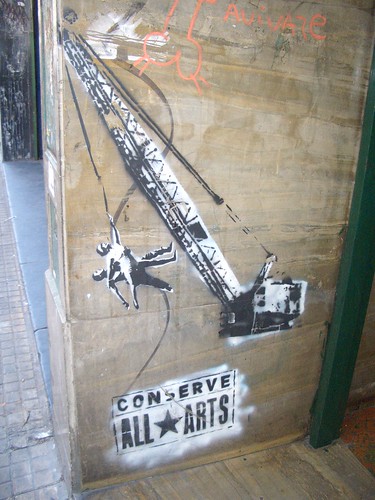
Time flies when you are sitting on your hole. Nearly a year ago I made a short trip to Argentina and was pretty taken aback at the highly developed street art culture my eyes were left to devour all around the city. You can have a taste of it from a large Flickr gallery I created to store the photos I took. Sometime after returning I contacted one of the collectives involved in putting this art up and got this interview down through the auld email.
Who are Vomito Attack and how did you guys come into being?
We began processing ideas after seeing the 9/11 attacks in New York City, 2001. After that we arrived in Buenos Aires in December and the crisis exploded. Without any possibilities of work possibilities, no money and a lot of free time - the project started growing. At first we did cut and pastes from newspapers and magazines changing the meaning of the contained information. Then we decided to use the streets as our main canvas, so we translated all that information to stencils and went out to paint.
Where's the name come from?
The name comes from how we recycle images, ideas and information. No fucking copyright exists for us. And also it's a peaceful and good way to get out all the shit that makes us sick.
A lot of the art I saw across Buenos Aires really seemed to be influenced by the radical politics prevalent during the economic troubles of 2001/02 - do you think that when the middle classes were out vandalising banks a space was created for street artists to put their work up on the walls of the city too?
Of course that was a big step to do whatever in the city, people were painting and destroying banks during the day, under the nose of the police - so at night it was easier to paint and do what you wanted on the streets.
During that time the city was in complete chaos, with a little bit of anarchy in the air.
Have you ever faced any hassle from the police when engaged in the creation of street art?
Yes - but just now beginning in 2007 - not before. In one week we had two incidents with police. During the second incident they made us erase what we painted. The problem now is that we are in an electoral year, both presidentials and major cith elections. And also we have a growing number of tourists coming to BA, so the city should look clean. Now in San Telmo we have a cop on every block.
What was the 'Vote PCM' campaign all about and where did you get the idea for it?
Political parties used to promote their candidates with "paintings" - using lime for the paint - which is very cheap. At the begining of the democracy in 1983 and during the eighties, people who painted the walls were all volunteers but from the nineties on it became a paid job. It's still the cheapest way to make political advertising.
 Two years ago, we started the VOTE P.C.M. campaign, on top of the same walls, using the same font but changing the color (because every party has a representative colour)we propoused to vote POWER, CORRUPTION AND LIES. (Poder. Corrupción. Mentiras).
Most of the art I came across seemed to be located in and arond the Plaza de Dorrego? Are there any other areas I should have peeled my eyes in?
Yes! There´s a lot of street art around the city - but the main hoods are San Telmo, Palermo, Congreso y Abasto. Also we saw several stencils in others states of Argentina, like Córdoba, Bariloche, Mar del Plata and Entre Ríos. Thanks to the Internet!
Is there much of a street art network across South America?
Not really. We have kind of Latin American version of the Wooster Collective, which is very useful to connect with others latin american artists. But in fact we (in bs.as.) received more visits from U.S. and Europe artists than from Latin and South America.
Is there any over lap between traditional writers/bombers and newer artists influenced by stencil and sticker work?
I don´t think so. There´s not many graffitti artists in Bs.As., spray cans are expensive here. Stencil is much more rebel in content than graffitti. The conection between both are spray cans and the streets as medium to express.
A lot of the statues of military figures and statesmen from Argentinian history in Buenos Aires were splashed with red paint or had stenciled texts about imperialism at their base. When was this done and how come the state never washed it off?
During the 90´s stencil was only used in demonstrations and by a few artists. After 2001 crisis become a very strong way to show ideas. The Internet is the most used tool now. The way through we received information from the outside world.
Many are fascinated by the Latin American tradition of murals - do you guys take any influence from this background?
Not at all. But the city has many murals, all of them make it with permission. We never ask for permission.
Aside from political pieces, many of the street art works I saw suggested a strong counter culture in Buenos Aires. Is this a fair reading and what form does it take?
Argentina has a very strong history of anarchist activism. Lots of italian inmigrants came here and spread anarchist ideas during the past century. We´ve an interesting background. And streets always were the better place to put the ideas.
Labels: Art, Interviews, South America, Street Art
(0) comments
Saturday, June 16, 2007
Hot Docs Interview: Moore and Me
 Again I think some version or other of this appeared in the latest Totally Dublin. This unedited interview contains a couple of hundred extra words, it's probably littered with spelling errors too. The photo to the left shows Rick Caine and his co-Director Debbie Melnyk, and the second captures a Saturday afternoon rush during the festival.
Rick Caine has been running the gauntlet of controversy across the documentary festival circuit this summer with his latest production Manufacturing Dissent. Sirring the pot first at South By South West and then Toronto’s Hot Docs, it's an acerbic look at the work of Michael Moore. Intended to explore what made a cine idol tick, along this journey Caine and his co-director Debbie Melnyk discovered that behind Moore's everyman malcontent facade lies a ruthless technique of self-creation. One that has left reeling friendships and burnt bridges, never mind a body of work stained by half truths bent for effect and out of context interview splicing. Caine, now based in Toronto where we caught up with him at the recent Hot Doc's Festival, is far from a neo-con detractor. His work is less a critique of Moore's politics than of his method, he simply believes power shaking documentarians must cling to a truth ethic or risk blowing their own foundations, and worse that of those sharing their views.
Do you think the world of documentaries has benefited from phenomenon that was Michael Moore at blockbuster level?
Yes, of course. Documentaries now play side by side with formulaic Hollywood fare in many cities and suburbs right across the world now. Michael Moore has played no small part in this documentary renaissance. His breakthrough documentary Roger & Me was the first time that a documentary was released outside of the traditional "art house" documentary ghetto. Of course wider audiences are interested in these kinds of films, but Hollywood has traditionally had the distribution channel sown up.
How has Hollywood sown up the distribution channel and can documentaries do much to challenge this?
At any given time 92% of the films showing across the world are American Hollywood films. There is of course much yet till to be done to break this monopoly and documentaries have no small role to play in this regard. And for documentaries, as a genre, it is ironically the best of times the worst of times. Michael Moore is amongst those on the best of time side of the equation.
His last film, Fahrenheit 9/11, had a production budget of US$6 million. The film grossed $125 million in the US and about $220 million worldwide. By any objective measure a remarkable and unprecedented accomplishment. But I also say that it is the worst of times because Hollywood still so thoroughly dominates the box office that we are currently in a situation where one can go to film festivals and see remarkable documentaries but all-too-frequently they will not be coming to a theater near you. Instead we will continue seeing Spiderman 3, Shrek 3, and on and on.
So while documentaries are struggling to escape the ghetto, Hollywood continues to fill theaters with entertaining, unchallenging, vacuous fare that audiences can choose to see or not go to the movies. It is still rare where there is any other option. But Michael Moore is among a select group of documentary filmmakers who are making progress in changing this dynamic. And we who believe think that once audiences get a taste of something else out there, that genie won't be put back in that bottle again.
So what is it that documentary making does better than your standard Hollywood fare?
One thing documentary filmmaking does incredibly well is that it can share the human experience of one person with other human beings, bringing us all closer together and strengthening our human bond. From a PR standpoint documentaries are a nightmare because PR is interested in only a one-sided truth, the white lie. Whereas documentary filmmaking aims to expose lies and not make them. But PR and advertising are interested in only the positive spin: Toxic sludge is good for you, light cigarettes don't cause cancer and you can eat almost nothing but bacon and lose weight (the Atkins diet).
And because we live in a world full of these white lies and one-sided truths, fuelled by big budget advertisers and well funded special interests we are all hungry (starved!) for the unvarnished truth. I have a friend that says the truth ain't couth but as we all have heard it can also set you free.
What is it that makes a documentary such a potent political tool as a purveyor of truths?
Immediacy, portability and the power of images. The medium, documentary filmmaking, is inherently powerful. Marshal McLuhan said the medium is the message. We've all heard that a picture is worth a thousand words, and this was written before the advent of the moving image. Documentary filmmakers are able to use feature filmmaking techniques to examine the messiness that is humanity, all the while with images trumping words, very powerful stuff. We don't write about the Iraq War, we take you to the front line. We don't describe the suffering of someone who has lot their son in war, we capture and then show you the experience and allow any audience to experience it first hand.
Another reason documentary filmmaking is such a powerful tool is it's portability. Al Gore can only be lecturing about the threat posed by global warming/climate change in one place at one time. But with a film his message is instantly accessible now and forever. And watching a film is a communal experience. Unlike passive Hollywood films that entertain but don't provoke thought or action, documentaries can stir the masses to action. Sometimes when documentaries end the discussion and action is just getting started.
 What should documentary makers do to make sure they are using this power instead of abusing it?
Always bear in mind that no matter how passionately you feel about any given social/political issue your values are not worth selling out just to make a point or to manipulate or mislead your audience into agreeing with you. The end does not justify the means. Do you think it's wrong to lie? Then don't do it. If you think it's important to treat others the way you'd like to be treated? Then don't take interview subjects out of context.
If a filmmaker chooses to tell the truth so many of these other things take care of themselves, including using the power instead of abusing it. It is occasionally painful to adhere to strict compliance with things like decency, fairness and truth but by disregarding these kinds of restraints the filmmaker ultimately does himself, his audience and sometimes his cause a disservice.
So with Michael Moore in mind, what are the consequences of the abuse of this documentarian power?
Part of the contention of our film is that when Michael Moore lies he gives the opposition a club with which they can bash everyone on Moore's side. "See they don't care about the truth. See they don't want honest political debate." If we think that the US president lying to the American public is not the way forward, how can we believe that the solution is having the opposition lie as well. Two wrongs don't make a right.
The title of the movie is a nice play on a Chomsky book title, after this movie will your aim remain on mainstream media shenanigans as it has with Junket Whore's expose of entertainment journalists lick arse relationship to PR and the Citizen Black portrait of media baron Conrad Black's cataclysmic fall?
Our next film is going to be fiction, but still in the same vein. It's about Lester Bangs, co-founder and music critic of Creem Magazine. Now he is the polar opposite of Michael Moore. He couldn't help telling the truth, he had an almost childlike honesty and was hated by many bands because he was so honest about their music. He died of an unintentional drug overdose at age 33.
How did the movie move from being a biography of Moore to a critique?
We always hoped that Michael Moore would cooperate in our look at him. Being political fellow travellers and Canadian and we'd heard thru friends that he liked the channel we'd been commissioned by to take a look at him, CHUM Television. So when Michael Moore's people began giving us such a hard time on a certain level we couldn't believe it. It was about this same time, approximately 4 months into our filming that we really started to struggle with our original concept and we felt we were at a crossroads. We began asking ourselves are we non-fiction (documentary) filmmakers or or we just going to stick with this sort of official biography about Michael Moore?
So when we hit this fork in the road we felt that morphing the project and going a different direction felt more like the truth than our original concept. So we changed it. But I have to say this is part of what we really love about non-fiction filmmaking. If one sets out in search of a story and it turns out to be something different then you're free to follow it. When we discovered so many skeltons in the closet, we felt we had no other choice than to turn it into an examination or critique of his methods and techniques and what the implications are not just for documentary filmmaking but for society.
We realized that when Michael refused to do an interview we would also have to follow him around to try and get any footage of him and soundbites to use in the film. We didn't expect his team to be bullies. When we realized what they were doing, trying to stop us from doing our film, we thought we should include it in the film because in a way, by showing the behind the scenes of a documentary we were getting at another level of truth. We couldn't believe when we got kicked out of Kent State and we thought others would find it shocking as well. We also felt at a certain point that documentaries should expose lies and not tell them. And if they chose to lie then they are part of the problem and not part of the solution. We regard this as the crucial issue of our time. We all want to live in well functionng democracies. That in turn is dependent upon a well informed electorate. And that depends on media that chooses not to lie and mislead the public. The horrific implications of this are obvious when one looks at how FOX News covered the lead up to the Iraq War. They don't even try to hide it. Roger Ailes was the head of the republican party and then he is runningand then he is running FOX News, doesn't get any more obvious than that. Fair and balanced my ass.
Before seeing this movie people might paint you as a neo-con detractor, didn't Fox News try and use you like this only to get a swift surprise?
FOX News assumed when they read about our film that we were in agreement with their agenda, which we aren't, and they also erroniously assumed that even if we weren't political fellow travellers that they could still use us to expose Michael Moore. For them the equation is really simple: If Michael Moore is wrong then ergo we must be right.
So in the lead up to our film premiering at the SXSW Festival several FOX News shows, both TV and radio, were chasing us insisting on interviews. We didn't want FOX to own the story and so we declined all requests from them. But then once the film had premiered at SXSW and other major media outlets had done interviews with us like CNN and MSNBC we agreed to go on a FOX News show because it had the name "Live" in the title (The Live Desk with Martha McCallum or something like that.) But we were cut off in short order after I starting discussing how some major news organisations, hello FOX, were not telling the American public the full truth and how that was causing problems for democracy and I remember I heard them in the IFB I had in my ear screaming "Get that asshole off the air."
Just after they pulled the plug (we were interviewed remotely and not in their New York studios) the cameraman looked at me and said "They had a five minute segment planned, but I think it run just under two minutes." "That was my fault," I said, "Guess they didn't want to hear what I had to say." From my point of view though this was a good thing. Where the right-wing U. S. media had been all over us now the only right leaning members of the U. S. media who called was because they wanted to argue with me, which I have done on their radio programs and what not.
Labels: Film, Hot Docs, Interviews, Politics
(0) comments
Friday, June 01, 2007
Drop The Lime Interview: "No Rave is the new Nu Rave was the old Neu Raev is now the neu! rayv!
 I linked off to a mix by Drop the Lime some time ago, it's one I've made the soundtrack to most of my bike commutes. More recently I had the pleasure of finally getting to see this self-declared heavy weight of New York Bass deliver a set at Crosstown in Toronto. He stands well tall over the decks, imposing and lanky shouting random exhortations to the crowd alongside enthused introductions to what ever tracks he's introducing to the mix. All the time he is building a pummeling wall of bass, and with the higher end of the mix well dipped it's sometimes hard to make out the vocal hooks that continuously suck you in on recorded mixes.
To my own confused drunken mind it was like he was excavating through dance culture, pulling surprising Chicago house tracks out from way back when and reminding the crowd that "this was twenty years ago" before moving on quickly in a whole other direction: be it the guitar crunched dubstep of Distance's "Ska" or some doo wap sounding oddity. His "electro banger" alter ego Curses! will be dropping the debut EP My House Is haunted! on Paris floor quaking label Institubes in June. The bucko himself drops by Kaboogie on June 22nd to serve up B-lines to ye Dublin feckers in Kennedy's over on Westland row. His latest music video is also up over on the Trouble and Bass blog.
Can you remember your first gig as a DJ and how it went for you?
I was 17 years old my name was DJ Dysis at the time and I played for a jungle/drum&bass night with Soulslinger, Pish Posh and TC Islam - I was smashing it, until TC Izlam came on to introduce Soulslinger while I was still DJ'ing and he said "who is this kid that nobody knows? blah blah blah blah" - rappin' about how I'm some nobody opening for Soulslinger hahaha, mad funny.
When did you make the move over to digital DJ-ing and how did it change things for you?
I still DJ with vinyl as well as Serato - Serato is useful for playing out unreleased material and new tunes I'm working on.. it's a good way to test the tune on a crowd and see if its ready to go public or if it still needs work in some places - plus exclusives from crews that nobody has heard yet.
You were in a lot of bands as a teenager, what sort of music were these making and has any of it rubbed off on what you are engaged in now? What finally pushed you in the direction of dance music?
I was heavily influenced by bands like Can, Fugazi, Sonic Youth, and Brian Eno - the constantly evolving style and sound in all of those bands and artists has been a continuos influence on what I do now.. Every summer as a kid I'd go to Italy and swim at this public pool, the radio would always be playing shitty euro house jams.. "this is the rhythm of the night..of the night.. oh yeah".. so the dance music sound has always been an influence on my songs.
When I was like 14 a friend of mine from London played me this mix-tape of DJ Hype, and I lost it. From that moment on I got this jealous feeling about Jungle music and that made me want to DJ and produce it, I started going to rave parties back home in New York and got more and more into electronic music, my copy of Zinc's "6 Million Ways" and "Zion08" sound like white noise all worn out now, cuz thats what I learned to DJ on.
This is a knowingly stupid question - but what's bass music all about? I know its a vicous blend of bass heavy genres but why do you think people are throwing genre boundaries out the window and going hell for leather at it for heavy duty bass?
Playing whatever you want to play as long as it has a nasty bass-line. Thats what counts. Jumping all over genres in a night is more exciting to me than one style all night long, as long as what holds the night together is bass. If you brought me some klezmer track that had a growling sub bubbling bassline holding it together I'd find a way to make it work with a B more or Electro or old school Chicago House tune, just because the bassline was so banging.
Dubstep is a pretty UK heavy sound and you manage to use it relatively distinctively - throwing US hip hop vocals over Skream's "Request Line" for instance in one mix - but is there a danger people will just labour after it as a purist sound, retarding the potential for something real interesting to come from its spread?
People tell me this a lot. I love dubstep and DJ it here and there, but its definitely a UK sound - I think every genre takes the risk of becoming washed out once it gets attention outside of the DJ scenes and into the people's homes... it's just about constantly putting out fresh material and pushing boundaries that will keep it strong, not how its mixed in a DJ set. When we in the Trouble & Bass crew mix hip hop or club rap with Dubstep it helps Americans who are unfamiliar with the sound become familiarized with something new.
What are your feelings on this whole "new rave" thing cultivated by magazines like NME and hooked on bands like the Klaxons?
No Rave is the new Nu Rave was the old Neu Raev is now the neu! rayv!
In the interview Dirty Down did with you you seem pretty down on blogs that release tunes not to promote the artist but to "have the tune" as you put it - have you ever been burnt by blogs doing this or by releasing material before you wanted it released?
Yes many a time. Sometimes a tune will get leaked thats unfinished or un-mastered, and then a blog will put it up and hundreds of DJ's will download it and play it out, even though in my ears it wasnt read yet. Really though, I have been supported massively by blogs, and I appreciate that.. its just that sometimes it wouldn't hurt to ask the artist or their label if they can post a specific tune up.. we probably will say "yes"..just ask. Most blogs do ask me or labels I'm affiliated with, and those blogs are A top on my list. Dirty Down, 20 Jazz Funk Greats, Palmsout, Acid-girls, Slap you in public and Fluo - they've all asked and have been really supportive of DTL and Trouble & Bass
Do you get the chance to do much graphic design which is one of your other interests or are you just totally absorbed in music?
I do most of the cover designs, t shirts, posters etc.. that are attached to my music..
For a while there you were associated with the aul hyper active use of the amen break, what was it about breakcore that you eventually found limiting?
The amen break!
You seem to love NYC right, I'm not sure if you've heard it but on the new LCD Soundsystem album James Murphy gives the world a pre-Giuliani-era lament in "New York I Love You" - how do you think the city has changed since 9-11?
Giuliani didnt like us dancing. I was born here and feel close to the big apple. People are dancing again though, and this whole "no dancing" cabaret law is dwindling away like a weak joke. I don't know the LCD soundsystem song, but I imagine its a different image of the city than my image.. I grew up as a raver, but I heard James Murphy grow up as a Skankin' Pickle fan.
Just going on pictures of Trouble and Bass parties I've seen on the net, they look like fairly small but sweaty parties - have they gotten bigger and how do you think they compare to parties like Bangface in London?
We do large and small parties from 300 to 1500. But now, we are moving towards only bigger parties - the small ones have been too sweaty and crammed. This was our last one with our boys, Cut in May (photo courtesy of the Captain at Dirty Down and there's more here).

And finally - do you think the E-lock video will be something to be embarrassed about in 30 years time?!
I plan on doing a sequel in 30 years.
The photo of Drop The Lime is nicked from the Onwards Charles Blog.
Labels: Breakcore, Drop the Lime, Drum and Bass, Dubstep, Interviews, Music
(0) comments
Friday, May 18, 2007
Captain Moonlight Interview: "I just couldn't take skirting around the issues any more."
 Barry must have been thinking exactly along the same lines as myself when he posted about Captain Moonlight some time last week. For a flash last year Moonlight received a glare of attention for a track called "Dirty Cunts." The track scratched the face of our gombeen elite with hip hop beats and a visceral abuse tempered with some precision angered comments on developers and corporate Ireland. Keen to avoid a critical discussion about politics, most media obsessed about his dirty, dirty cursing and treated him as a once off hip hop oddity instead.
Moonlight's guttural rhyming patterns strike like a lyrical hot poker into the heart of Celtic Tiger Ireland to expose alcohol crippled lives, sharp cultural clashes of class and a deep seated alienation from politics as done, that "same auld, same auld shite." Moonlight is a very capable musical voice for a slowly growing Irish social movement, a transmission point for social woes that rarely get adequate treatment in the main media, and that is hip hop at its most traditional. In this interview carried out for Indymedia I catch up with the good Captain about politics, that track, voting and the demon delight of booze...
Labels: Captain Moonlight, Hip Hop, Interviews
(1) comments
Saturday, March 31, 2007
Interview: Let's Get This Super Extra Bonus Party Started
 Dublin based purveyors of jump up electronica, Super Extra Bonus Party have a name so full mouthed you'll be lucky not to choke on it. Made up of Cormac Brady and Mike Donnelly on all things machine like such as synths, samples, production and scratching, with occasional input from Sean Corcoran , then Stephen Fahey on bass, guitars, trumpet, with Gavin Elsted whacking drums and occasionally on guitar and the blogosphere's own Nialler9 on visuals.
 Any time I've seen them, their fast paced live sets of swirling bleeps and beats were hyped on by the MC-ing of Brazilian Rodrigo Teles, but they are equally capable instrumentally - making for stellar live shows at Mantua and left of centre electronic dealership Alphabet Set's Christmas party. After a string of positive reviews from both Hot Press and Mongrel, Super Extra Bonus Party have been hiding away in their bat-cave for the past few months working on a new album. Lured out with a trail of tepid Buckfast, we trapped Cormac Brady for a quick interview.
What's the background to the group? Don't most of you have a shared tragic childhood as part of some itinerant Newbridge travelling circus? Is it a continuation of the Illegal Kids and who were they anyway?
Nah it’s not a continuation of the Illegal kids, although we do retain some of the ways we used to write tunes then, we regard SEBP as a totally new thing. The first SEBP gig was in November 05, we wrote three songs to play at an open mic session in a pub in Newbridge, Mike played the sampler, fats played bass and guitar, and I played a shitty little toy drum kit and an equally shitty and ancient casio keyboard. That’s how the band formed, we got together to do that session, then we just kept writing together after that. The gig itself was all over the place, the kick pedal on the kit decided to work whenever it felt like it, and the effects on the sampler cut the ears off a few people, but the crowd liked it because we weren’t a singer song writer, and we took that as encouragement. And yeah, against all the odds we’ve all overcome the mental turmoil resulting from our childhoods with the Newbridge travelling circus, and that’s what all the tunes are about. Although Fatsy still has flashbacks, and I still do the odd nixer.
So how did a Dublin based music collective manage to stumble across a Brazilian MC in the gritty old town of Dublin? He quite adds soemthing to the live set, but you've played without him before so just how integral is he to the set up at the moment?
We put an ad in the Parish Bulletin for a Brazilian MC. The response was overwhelming so we held auditions in the town hall. Rodrigo just stood out from the rest. We were doing instrumental shows for a long time before he started jamming with us, so we still enjoy doing those shows when he’s not around, and when he is around, all the better. We find that our gigs work both ways, there’s always a lot of sound going on between guitars, bass and electronics. Rodrigo by the way is in Brazil at the moment, the lucky fucker, but he’ll be back soon.
The website and graphics for the band present you as an overly smiley bunch of gee eyed kids on a Smarties session - what the fuck is all that about and just where does that name come from?
Yeah, we’re really a bunch of depressed fuckers. We came up with the name for that open mic gig I was on about and then stuck with it. We wanted a name with balls. Whether it has balls or not is up for debate, but we like it none the less. Also we quite enjoy listening to people fuck it up when they introduce us at gigs, and explaining it to taxi drivers when we’re heading to gigs with all the equipment is always fun!
Its strikes me as unusual you have Nialler down as a member of the collective for doing visuals - are visuals and graphics important to ye?
Well, we’re calling ourselves a band now. Niall makes visuals specifically for each of our tracks, that’s a huge amount of creative input that comes through in the live shows. So yeah, for live shows he’s part of the whole experience and therefore part of Super Extra Bonus Party. He takes care of the visual side of things, and we do the tunes. We all collaborate on the artwork for sleeves and stuff.
Why do you call yourselves a collective as opposed to just a plain old simple band?
The collective idea stems from the fact that we love collaborating with people, and that so many people have played gigs with us, we’ve had had six people on stage at times. But we’ve since reverted back to calling ourselves a band, the collective thing was just throwing people off, and us too I suppose!
How do you lot feel about things in Dublin at the moment in terms of the general electronica/whatever scene?
Most of the electronic gigs I’ve been to recently have been packed out, which is encouraging. The recent Alphabet Set Christmas party we played in the Voodoo Lounge was an example, the place was jammed and that’s quite a big venue. Also, there are always innovative new acts coming on the scene, check out Nouveau Noise for example, I was introduced to their tunes recently by a friend. There’s a serious amount of talent floating around the country at the moment if you look for it I think, not just in the electronic scene, in general.
What's been the best gig you've played to date?
Hmmmm… It’s a throw up between Mantua Lives in August '06, Alphabet Set Christmas Party last December and the NCAD ball, they were all a good laugh. The mental ones are best.
According to your website you'll have a debut album out in April, how's work going on it? You seem fairly fond of the old collaborations.
It’s coming along really well, there’s a good buzz about it, there’s loads of interesting collaborations on it and lots of styles too. Right now we’re putting finishing touches to tracks we’ve done with Nina Hynes, White Noise (the human beatboxer), Paul O’Reilly from Channel One and Ian and Collie from Kill City Defectors. It’s a shitload of work, but it’s what we love, and we’re really happy that all those heads liked the tunes we gave them. We can’t wait until it’s all complete, if we could ditch the day jobs and do it for a living that would be fucking sweet!
The BBC have used you a track by you, Hot Press have recommended a demo - would you be happy to trundle around the Dublin scene with these few accolades or do you yearn for something bigger and better?
Speaking in terms of the upcoming album, we have a lot of confidence in it, so we want as many people to hear it as possible, and we want to get copies of the album to as many places as possible, and we want to do as many gigs and hopefully festivals as possible. That’s the plan.
The Super Extra Bonus Party album launch night is on April 13th in the Voodoo Lounge with Herv, noise-sters Terrordactyl and Kill City Defectors. €TBC. Their previous EP is in mp3 format on www.superextrabonusparty.com and their forthcoming album will soon be availible to buy there too.
Labels: Interviews, Music, Super Exta Bonus Party
(3) comments
Tuesday, March 13, 2007
DJ C Interview: Mashit's Mashup Maestro
 Nothing has turned me onto as much ass quaking good music this past year as the track listings of DJ C mixes. Dealing in nuthin' at all but the best dance floor shakers, DJ C and his endless output is a man to pay attention to. Rampaging across genres for the ultimate ass jiving party sounds to spice up his own Boston bounce, DJ C doesn't hold back with the output. At the centre of the recent brilliant bastard rebirth of jungle fronted by showstoppers like Aaron Spectre, Mashit deserves your categoric full attention. Especially as it generously throws all of their artists output up on the net for free download.
Take a track like DJ C's Quality Diamond colloboration "Let It Billie," remashing a classic regaee version of Jackson's Billie Jean with some infectous jungle rattle that will make even the heads of the most cynical "breakbore" detractors turn. Those excited by his more recent dancehall flavoured colloborations with Chicago vocalist Zulu will be delighted to note the forth coming releases "Body Work" and a 12 inch called "Darling" with a remix by Montreal's Ghislain Poirier, both on Community Library and distributed in the UK by Baked Goods.
The early release of three tracks from his "Sonic Weapons" debut album on Bristol's Death $ucker Records will awake the attention of any genre blenders rapt to the sucker punch surprises of his copious "B" series mixes. In this interview DJ C tocuches on the frustration of experimentalism prior to Rupture's mash mainlining, Bush's re-election and how Mashit intends to kit itself out for musical distribution in the digital DJ-ing era.
What's the "C" stand for?
Whats this boston bounce all about and will my elderly rural parents like the waltz aspect of it?
How did you get drawn into music and DJing and when did you come to really start to obssess about it as a DJ?
You are part of the Riddim Method collective which takes an almost academic approach to mixing and the relationship between different forms of music, can you tell me how this collective nerding came into being and whats its purpose is?
We're all part of the Beat Research crew too. Flack and I have been running Beat Research as a weekly event for the past 3 years, and have had over 100 guest performers/DJs come through. The members of the Riddim Method crew are kind of like auxiliary Beat Research residents. The Riddim Method blog began when we realized that another group of DJs had started a blog at beatresearch.blogspot.com and we were like "Hey! that's our thing." In was actually really positive as it inspired us to start our own group blog. It's really just a forum
to talk about stuff we're into.
You and others in the Riddim Collective frantically blog about music, how do you think music blogging has affected underground music scenes?
On the Mashit label you give away tonnes of free MP3s, do you not think you are taking a needless hit through this given the whole debate around music piracy? Also how come some tracks never seem to end up as pay-for-download after vinyl releases? I'm thinking of Gone-a-Jail here which an awful lot of people must want.
In the past couple years there's been a big shift in the DJ industry, though; a landslide of folks shifting over to digital DJing. This has been fueled by the coming-of-age of CD players that feel like vinyl, and real vinyl controllers for digital libraries. I use Serato Scratch Live which uses time-coded vinyl records to control my iTunes library on my laptop, and it's completely opened up the way I DJ. Like it or not, this is putting a serious dent into the vinyl industry. Many major vinyl distributors and stores have been going under. Don't get me wrong, there are still a lot of folks who do use vinyl, including me sometimes, but the tides are turning.
Needless to say, Mashit's original business is doesn't apply as well today, but that's OK. Because it's incredibly cheap to distribute music digitally, and now that so many folks are DJing digitally, that's what we'll focus on going forward. Mashit will be re-tooled for the future over the next year or so.
Are your mixes fully hands on and what sort of set up do you need for a show?
material as a continuous mix while tweaking, dubbing, looping, and effecting things on the fly. I looked at DJing as a way to present other peoples music, for the most part. I'm not looking at ways of combining these together, and blurring the lines more. No need to compartmentalize, ya know?
I spent most of last summer insisting people listen to the Bouncement mix, what's your own favorite in the series and why is there such a series in the first place?
The series began just because I had ideas for so many mixes the names of which start with the letter "b". I've still got a lot more up my sleeve. Perhaps it will shift to a different letter at some point, though.
The new Traced Milk EP really shows a more chilled out side to you, how come this is hidden away in your non-stop party mixes?
There's a set on my site, on the "Music" page, called "Mid '90s Style Chillout Set." It was recorded in '02, but consists of stuff I used to play back in '95/'96. Back then I recorded under the name Electro Organic Sound System. I had an album out in '96 of ambient/chillout-ish stuff, and another album out in 2000, which began to bridge the gap between my more chill and the jungle/breakcore side.
In one interview you described how impossible experimentalists in Toneburst found it to get club gigs back in the day, what sort of venues did you end up using?
You sometimes get characterised as 'one of those new fangled breakcore djs' when your sets are anything but confined to one genre, how do such off hand descriptions make you feel?
A blurb on Mashit describes how the anti-Bush mix you released prior to the election was part of a protest music "alive and well" because of the net, do you think the net facilitates other forms of dissent stateside or is it all right wing/neo-con bloggers?
has struck fear into the hearts of journalists. On the other hand, the media has to keep afloat when they're losing the attention of consumers to the internet. It can be difficult to weed through all the conflicting info, but you can't say the system's not open. I'm also an avid listener to National Public Radio which generally does a great job of presenting news and information.
In a Spannered interview Ripley described being active as a street medic, were you ever active in the post-Seattle protest upsurge or do you think music is the best medium you have to make political gestures? You were involved in a group called BEATS NOT BOMBS?
darkly shadowy day.
Do you have much contact with Trouble and Bass and otherstate side crews doing vaguely similar things as yourself? Where should people look to follow whats happening on that side of the Atlantic?
Labels: Breakcore, DJ C, Interviews, Music
(0) comments
About Soundtracksforthem specialises in iconoclastic takes on culture, politics, and more shite from the underbelly of your keyboard. A still-born group blog with a recent surge of different contributers but mainly maintained by James R. Big up all the contributers and posse regardless of churn out rate: Kyle Browne, Reeuq, Cogsy, Chief, X-ie phader/Krossie, Howard Devoto, Dara, Ronan and Mark Furlong. Send your wishes and aspirations to antropheatgmail.com
Label Cluster
In no certain order...
Politics,
Guest Bloggers
Interviews,
Music,
Internet,
Guest Bloggers,
Travel,
Blogging,
TV,
Society,
Film,
Gig Reviews,
Art,
Media.
The Neverending Blogroll
A Womb Of Her Own
Arse End Of Ireland
BlissBlog
BBC One Music Blog
Blackdown Sound Boy
Buckfast For Breakfast
Customer Servitude
Counago & Spaves
C8
Candy PDF Mag
Guttabreakz
House is a Feeling
Homoludo
Infactah
Indymedia
Indie Hour Blog
Jim Carroll
kABooGIE MusIC
Kid Kameleon
Kick Magazine Toronto
Libcom
Matt Vinyl
Modern Cadence
Mongrel
Nialler9
One For The Road
Old Rotten Hat
Pitchfork
Salvo
Spannered
Sigla
Test
Thumped
Newish Journalism
TV Is Crying
Uncarved
Una Rocks
Urban75
Weareie
WSM
Wooster
Village Magazine
Radical Urban Theory
Archives
February 2002
October 2002
April 2003
September 2003
November 2003
December 2003
January 2004
February 2004
March 2004
June 2004
September 2004
January 2005
February 2005
March 2005
April 2005
June 2005
July 2005
August 2005
September 2005
October 2005
November 2005
December 2005
January 2006
February 2006
March 2006
April 2006
May 2006
June 2006
July 2006
August 2006
September 2006
October 2006
November 2006
December 2006
January 2007
February 2007
March 2007
April 2007
May 2007
June 2007
July 2007
August 2007
September 2007
October 2007
November 2007
December 2007
January 2008
February 2008
March 2008
Gig Review: The Fall Tripod
Gig Review: Gogol Bordello
Broken Pencil Gets It's Irish On
Fecking Civil Servents
Fake Pharma Ads
Vidiot: Data Entry
Life and Debt
Last Night Cosmo Baker Saved My Life / Hip Hop His...
Eye Candy: Dufferin Hoarding Gallery
Review: Heads for the heart of the Sun – The Welco...