
Friday, December 07, 2007
Bolivia: Social Movements On Fire.
 Over the weekend of November 24-25th, protesters clashed with police in Sucre, Bolivia - they were demanding that the capital of be moved there. Three people died and over some 100 were wounded in the clashes. Yesterday Morales announced plans for a nationwide referendum to resolve a deepening political crisis in the country. A few months ago, two recent works on Bolivia were given a look over for the WSM's Red and Black Revoltuion 14, the review appeared on Indymedia.ie first and here it is for you blog readers
A few years ago the Cochabamba water war coincided perfectly with the 2000 anti-globalisation peak to solidify many of that movement's arguments about neo-liberal rule in cold hard scenarios of struggle. An exciting new round of images depicting indigenous women confronting militarised police dotted left publications, while documentaries like 'The Corporation' used the revolt as a sharp anecdote in hacking off the avaricious tentacles of multinationals.
A review of "The Price of Fire" by Ben Dangl and "Impasse In Bolivia" by Benjamin Kohl and Linda Farthing.
With the success of the Movimiento al Socialismo (1), western attention moved from the social movements honed in such resource struggles to the left caudillo Morales and, despite previous excited flutters, there's now little comment on how the grassroots relate to this new moment.
Al Giordano complained in a recent book on Oaxacca, that the radical press often shares problems with the mainstream - reeling in a journalism of instant replays, full of heroic and tragic moments from the barricades, instead of cogent analysis.
Thankfully in the past six months two very different books sought to pierce through the frailty of movement reportage on social movements in Bolivia, to explore why they emerged with such force since the 1990's and how they now relate to the MAS.
The first of these is Kohl and Farthing's 'Impasse in Bolivia', a heavily wrought background to the face off between a globally prescribed neo-liberal hegemony and a local population repeatedly drawing on a five hundred year resistance narrative.
Taking the reader through a well-elucidated history from the Spanish Conquest to the early 21st Century, they track how economic restructurings affected the composition of Bolivian resistance movements prior to neo-liberalism.
The exploitation of silver deposits at Potosi by the Spanish profoundly re-organised Andean society, leading to the emergence of indigenous resistance through nested kinship structures that fuelled rebellions such as the mythic 1781 siege of La Paz from the alti-plano by tens of thousands of Aymara warriors.
The authors describe how the later drive for an independent Bolivia stemmed from liberal criollos keen for the benefits of their own state but bent on uprooting and modernising indigenous communal land-holding systems to fundamentally exclude them as citizens.
The eventual replacement of these hacienda based elites with natural resource companies at state level set the ground for embryonic industrial agitation and ripples that reach the present.
In the thirties a rivalry between Standard Oil and Royal Dutch Shell over control of deposits in the Chaco region forced Bolivia into a proxy war with Paraguay for control of the disputed area. Defeat both drastically reduced the country's land mass and welded the social force for the 1952 Revolution among war weary drafted students, workers and campesinos.
The resultant Movimineto Nacional Revolucionaro deposed the mining oligarchies with a regime subject to land and labour pressure from below in the form of the Confederacion Obera Bolivian. Forced to recognise land seizures and labour demands, it constructed a state in the modernist nationalist tradition with a strong central administration and control over natural resources.
This defiant union movement continued to push for a deepening of citizenship rights only to be marshalled with a military dictatorship in 1964 as Cold War realities hit home.
The imposition of neo-liberal economics in the eighties under the NEP against this historic background becomes quite central to the authors' account, seen as a serious attack both on what became known as the "State of '52" and the labour movement.
Engineered for president Estenssoro by Jeffery Sachs of the IMF, it was the first programme of its kind, leading to some economic recovery in the face of hyper-inflation but an ensuing human misery.
Over 20,000 miners lost their jobs, manufacturing collapsed and over two thirds of the urban population were dragged into the informal economy, dramatically paralysing the COB as the backbone to popular struggles.
With the way paved for an affirmation of neo-liberal policies, Gonzalo Sanchez de Lozada's Plan de Todos in the nineties unfolded with the familiar theme of privatised state owned enterprises, gutting the country's revenue.
Yet according to the authors, the couching of this new market democracy in electoral and social reforms inadvertently opened a space for indigenous resistance in rural areas.
As failed neo-liberal promises bolstered anger, diverse movements around coca eradication in Chapare, land rights and basic urban services quickly transformed the political landscape to "forge a common sense of injured national identity (2)."
Unfortunately Kohl and Farthing's work is hamstrung with the distance of academia, it sketches the imposition of neo-liberalism brilliantly but fails to illustrate "the shape that popular challenges to it will take (3)" in any grounded way.
Using a very different approach Benjamin Dangl's 'The Price Of Fire' is refreshingly intimate, he too starts with a "revolution in reverse," rolling through the tides of Bolivian revolt during a brief stay in old Potosi.
His writing style is steeped in hauntology and the psychic scars of centuries of exploitation; it's the fruit of bar room conversations, pickets and blockades and a brief encounter with Morales. He cushions this in minor analysis and travelogue, allowing voices from social movements to provide a "human face to the looting and struggles of a continent (4)."
During a visit to the Chapare, this "bearded gringo with a notepad" rails against the use of coca eradication as a paltry excuse for US intervention in the post cold-war climate, arguing that the migration of unemployed miners to rural areas accelerated coca's growth as the only viable cash crop under neo-liberalism.
From this dynamic the MAS emerged, capable of unifying different strands of struggle with its origins in coca growers' unions formed by former miners. Visually this is seen in the use of the coca leaf as party insignia, once used for energy by silver miners but equally evocative of indigenous and anti-imperialist messages today.
The book continuously traces how modes of militancy spread through migration. Like Farthing and Kohl, he agrees that the water war was a momentous turning point with the practice of mass assemblies in rural areas becoming more engrained in cities through the Coordinadora.
Retaining a critical eye, he doesn't rush to romanticise the end result of the water war. Bechtel may have left but the public water company is still controlled by a local political elite, though one more subject to street based popular power.
The question of how to use Bolivian gas further unified traditionally diverse social movements in the 2003 gas war to reverse the privatisation carried out in the mid-nineties. Protesters used "the wealth underground" as a point of correction for past lost resources and to envision a future of possible development, education and health-care.
Casting his eye to Caracas, Dangl hints at the use of oil revenue in Venezuela to empower the nation's poor with literacy programmes, health clinics and community centres as a path for the Morales regime.
'The Price of Fire' takes a brief jaunt into urban geography in a chapter on the internal world of the El Alto, a city whose residents played a crucial role in the 2003 gas revolt. The same social forces that drove miners to become cocaleros in rural Chapare led to the informal settlements outside La Paz skyrocketing to a population of 800,000.
Neighbourhood organisations sufficiently ingrained to strangle the capital below in periods of struggle, sprung up based on the experience of miner and rural agitation, as well as the absence of basic state services. One of the few academics Dangl speaks with describes their strength as lying in "the basic self-organisation that fills every pore of the society and has made superfluous many forms of representation (5)."
Within these El Alto urban movements we are given glimpses of a counter-cultural response to neo-liberal hegemony in Teatro Trono, a theatre group meshing struggles against the IMF with traditional myths in popular education programmes. There's also a growing hip-hop movement that fuses the Aymara language with sampled stateside beats into a poetics of urban resistance to poverty.
In his conclusion Dangl takes a critical look at the problem fraught Morales' regime. He claims that images of troops entering gas fields from afar look like the stuff of radical expropriation but nationalisation really meant a series of buy outs of majority stakes sold for a pittance in the 1990s, higher taxes and a re-negotiation of over generous contracts.
Stepping aside from the flurry of rhetoric surrounding nationalisation, the YPFB in reality still remains at a capital disadvantage with international companies holding minority shares.
Rarely mentioned in discussions of Bolivian social movements is the traditional demand for a constituent assembly convoked by Morales this year. Many of the movement activists we meet through Dangl's travels complain that the electoral nature of the assembly excludes them, forcing them to abandon their autonomy and seek representation through the MAS party.
Simultaneously it has reinvigorated right wing parties weakened by the popular rebellions, allowing them the space to develop a dangerous language of autonomy for oligarchical strong holds like Santa Cruz.
If you are looking for long streams of statistics on Bolivia's immiseration, then Farthing and Kohl have compiled a resource for your agitational pot-shots and filler articles - but if you want the human face of Bolivia's social movement push, then Dangl is your only man.
Whichever you prefer, Bolivia remains a fertile soil for the rebellious imagination, full of "better worlds- some that have lasted and some no more than euphoric glimpses (6)."
(1) Movimiento al Socialismo (Movement Towards Socialism) is the party of Evo Morales.
(2) Kohl, Benjamin and Linda C. Farthing. Impasse in Bolivia: Neoliberal Hegemony and Popular Resistance (Zed Books, 2006) p175
(3) Ibid p23
(4) Dangl, Benjamin. The Price of Fire: Resource Wars and Social Movements in Boliva (AK Press, 2007) p11
(5) Ibid p151
(6) Ibid p9
Check out Upsidedownworld for an analysis of the latest tensions.
Labels: Bolivia, Literature, Politics, South America
(0) comments
Thursday, November 22, 2007
Avi Lewis On Occupied Factory Movement In Argentina: "This phase is less overtly political, certainly less overtly revolutionary."
 Anyone living in Toronto, a city with sidewalks wheat-pasted wildly with posters knows this; the Brunswick Theatre is creating an extraordinary space in a city bereft of places to engage with cinema. Regular discussions and talks happen, with documentaries sharply matched to a purpose rooted in popular education. If there is a criticism, it's that ticket prices are pretty steep. Last night's Avi Lewis lecture cost 15 dollars, but running a cinema at the location and with the frequency they do can't come cheap.
The poster for this screening foregrounded Lewis' public lecture, so at the start a moment was taken to see if watching the movie was actually worth while. Just over half of the raised hands had already seen the 2004 documentary that follows the fortunes of workers in the Forja auto plant as they struggle to turn it into a worker cooperative, yet the organisers ploughed ahead as planned. Using it to give ground the inevitable more abstract discussion to follow in human insight to the recuperated factories movement.
The night also doubled as something of a launch for Haymarket Book's translation of Sin Patron, a collection of interviews with participants in the recuperated factory movement. Lewis called this "a living document in the words of the workers themselves with an absurdly, provocative and piercing analysis by the Lavaca collective." A second edition is coming out soon with updates from some of the 160 something factories and workplaces indexed at the back of the present edition.
Shortly into The Take, there's a montage of boorish interviewers throwing demands for alternatives at Klein, so she explains the purpose of the movie as a search for alternatives outside the model of neo-liberal development. On the night Lewis glanced back at The Take as a glimpse of a moment in very recent social history, where large swathes of people realised "that changing pieces on the chessboard is not really changing the game." This bursting of the ideological bubble in a country where even the street signs were brought to you by Mastercard under Menem needs a closer look now that Argentina has largely stabilised, again "in the grips of a capitalist dream, where Kirchner does a good job of railing against the IMF, a bit like the NDP here, yet governs to strict IMF rules."
After the film with attention rapt for updates since it was made, the most pertinent question as Lewis saw it was more abstract: "is there a memory of struggle there, just beneath the surface? Is there a strengthened social movement that has built real bases in the communities and the workplaces?" The tone of his voice suggested a very optimistic "yes."
He'd just spent an hour and a half talking to somebody who works with This Working World in Argentina prior to this Brunswick talk, so Lewis was able to give some decent updates on the state of play in the factory movement at the moment: "this phase is less overtly political, certainly less overtly revolutionary as it deals with the nuts and bolts of making sustainable businesses work."
A friend of Zannon's ex-owner, who appears in the film as a cliche of bourgeois vampirism with the champagne bottle lurking in an ice bucket in his opulent office, recently used his position of governor of the province to run for president. The discourse he used in his campaign was largely a return to the language of the dictatorship, but he got less than 1% of the recent vote. Zannon under workers control now employs 480 people and provides more than the domestic demand for ceramics in Argentina.
On a visit to the Brukman suit factory that is dramatically re-occupied in the film, Lewis couldn't find anyone to talk to him, forcing him to comment that: "if there's a social movement or co-operative that doesn't need journalists; then you know its a success.
More recuperated businesses are coming on stream, including a landscape gardening co-op that works creating city parks. This sector tends to be controlled by Mafia type groups linked to Peronism so it was necessary to use political force for the city to sign a contract with them. Using the strictures created by the business practices of the previous operators, the new co-op was able to pull a massive scam loan legally to fund other co-ops in the region. A meat packing co-op has been set up that employs 800 people, a river boat casino is coming under workers control and the only balloon manufacturer in Buenos Aires is under workers control and supplies the whole province.
On a bleaker note many of the recuperated factories and businesses will be facing new difficulties as the legal system allows only a two year term of expropriation. With workers successfully turning failed businesses around, the bosses may try coming in through the back door of the courts leading to hazards ahead. The balloon co-op for instance may have to up stakes and use its capital to open elsewhere. For a movement that has concentrated so much effort on carving out spaces of dialog and popular education with communities, this geographic displacement may well blunt part of their projects, leaving them more easily prey to future evictions.
Labels: Argentina, Class, Film, Politics, South America
(0) comments
Monday, August 06, 2007
Interview: Vomito Attack On The Streets of Buenos Aires.
Time flies when you are sitting on your hole. Nearly a year ago I made a short trip to Argentina and was pretty taken aback at the highly developed street art culture my eyes were left to devour all around the city. You can have a taste of it from a large Flickr gallery I created to store the photos I took. Sometime after returning I contacted one of the collectives involved in putting this art up and got this interview down through the auld email.
Who are Vomito Attack and how did you guys come into being?
We began processing ideas after seeing the 9/11 attacks in New York City, 2001. After that we arrived in Buenos Aires in December and the crisis exploded. Without any possibilities of work possibilities, no money and a lot of free time - the project started growing. At first we did cut and pastes from newspapers and magazines changing the meaning of the contained information. Then we decided to use the streets as our main canvas, so we translated all that information to stencils and went out to paint.
Where's the name come from?
The name comes from how we recycle images, ideas and information. No fucking copyright exists for us. And also it's a peaceful and good way to get out all the shit that makes us sick.
A lot of the art I saw across Buenos Aires really seemed to be influenced by the radical politics prevalent during the economic troubles of 2001/02 - do you think that when the middle classes were out vandalising banks a space was created for street artists to put their work up on the walls of the city too?
Of course that was a big step to do whatever in the city, people were painting and destroying banks during the day, under the nose of the police - so at night it was easier to paint and do what you wanted on the streets.
During that time the city was in complete chaos, with a little bit of anarchy in the air.
Have you ever faced any hassle from the police when engaged in the creation of street art?
Yes - but just now beginning in 2007 - not before. In one week we had two incidents with police. During the second incident they made us erase what we painted. The problem now is that we are in an electoral year, both presidentials and major cith elections. And also we have a growing number of tourists coming to BA, so the city should look clean. Now in San Telmo we have a cop on every block.
What was the 'Vote PCM' campaign all about and where did you get the idea for it?
Political parties used to promote their candidates with "paintings" - using lime for the paint - which is very cheap. At the begining of the democracy in 1983 and during the eighties, people who painted the walls were all volunteers but from the nineties on it became a paid job. It's still the cheapest way to make political advertising.
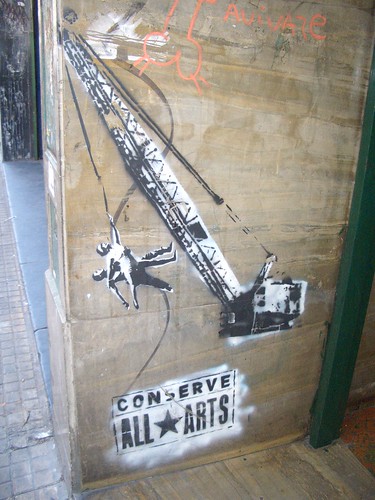 Two years ago, we started the VOTE P.C.M. campaign, on top of the same walls, using the same font but changing the color (because every party has a representative colour)we propoused to vote POWER, CORRUPTION AND LIES. (Poder. Corrupción. Mentiras).
Most of the art I came across seemed to be located in and arond the Plaza de Dorrego? Are there any other areas I should have peeled my eyes in?
Yes! There´s a lot of street art around the city - but the main hoods are San Telmo, Palermo, Congreso y Abasto. Also we saw several stencils in others states of Argentina, like Córdoba, Bariloche, Mar del Plata and Entre Ríos. Thanks to the Internet!
Is there much of a street art network across South America?
Not really. We have kind of Latin American version of the Wooster Collective, which is very useful to connect with others latin american artists. But in fact we (in bs.as.) received more visits from U.S. and Europe artists than from Latin and South America.
Is there any over lap between traditional writers/bombers and newer artists influenced by stencil and sticker work?
I don´t think so. There´s not many graffitti artists in Bs.As., spray cans are expensive here. Stencil is much more rebel in content than graffitti. The conection between both are spray cans and the streets as medium to express.
A lot of the statues of military figures and statesmen from Argentinian history in Buenos Aires were splashed with red paint or had stenciled texts about imperialism at their base. When was this done and how come the state never washed it off?
During the 90´s stencil was only used in demonstrations and by a few artists. After 2001 crisis become a very strong way to show ideas. The Internet is the most used tool now. The way through we received information from the outside world.
Many are fascinated by the Latin American tradition of murals - do you guys take any influence from this background?
Not at all. But the city has many murals, all of them make it with permission. We never ask for permission.
Aside from political pieces, many of the street art works I saw suggested a strong counter culture in Buenos Aires. Is this a fair reading and what form does it take?
Argentina has a very strong history of anarchist activism. Lots of italian inmigrants came here and spread anarchist ideas during the past century. We´ve an interesting background. And streets always were the better place to put the ideas.
Labels: Art, Interviews, South America, Street Art
(0) comments
Tuesday, February 27, 2007
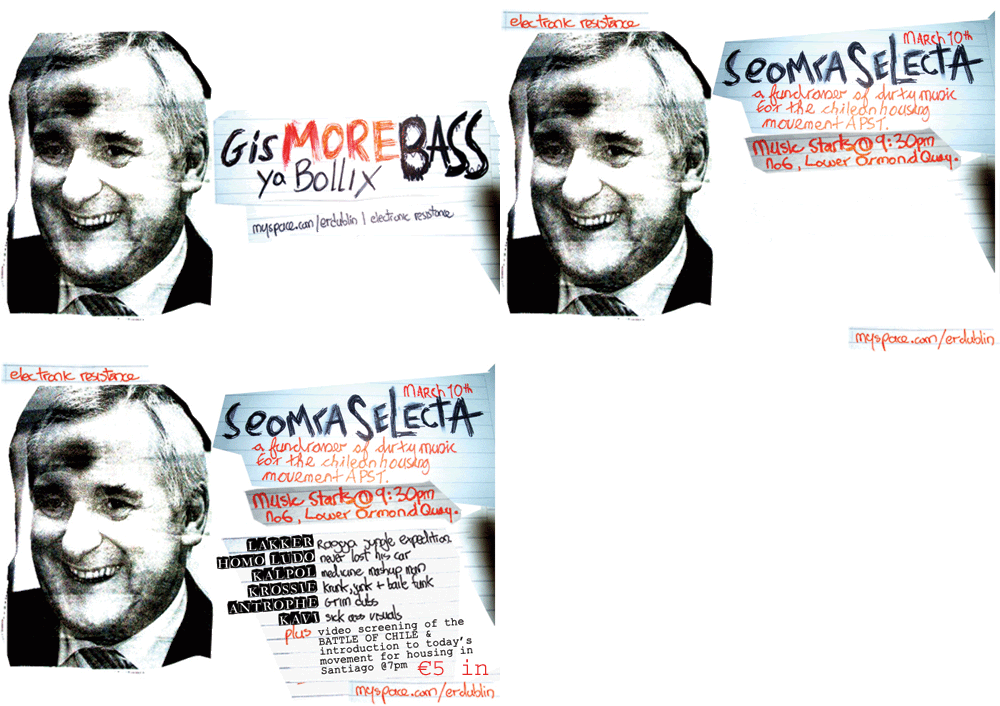
Seomra Selecta! A Night of Drity Music For the Chilean APST
 When passing through Chile I stayed with some members of the Agrupación de Pobladoras y Pobladores Sin Techo (APST). That mouthful basically translates into the organisation of those without roofs.
There's no real corresponding word for popladores in English, it's essentially a term for those dwelling in the popular communites, that is where most people live and of course in societies with sharp economic contrasts this is term is conflated with a lower economic status.
Those I met from the organisation were active in the historically fascinating district of Nueva Habanna - an area of land occupied by the revolutionary left wing movement MIR under the space afforded by the Allende regime in order to build housing for overcrowded workers. In a documentary we watched on the movement you got a real glimpse of the optimism of the period prior to the Pinochet coup and the magnificent effort that a whole newly formed community invested in an effort to build a school, playground resources and housing for about forty families on what was once an idle farm.
When the dictatorship came to power, the area was placed under military occupation and practically all of the activists whose determination and effort alongside their communities had birthed what the state had failed to provide "housing with dignity" were rounded up and executed. The name of the area was changed to New Morning to negate the communites postive nod towards Cuba.
The city of Santiago eventually grew up and crept around the site where the housing movement made its stake for land, and its now an island in La Florida one of the main barios in Santiago. Walking through it you can see the playground and school (ironically now used by a church group) built by the movement.
Locals can point out to you how the Pinochet regime broke the solidarity conciousness of the community by offering those with money the ability to buy out the collectively built high standard houses and forcing the rest into shabbily constructed council house equivalents.
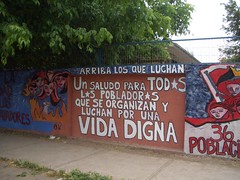
Those active in the APST in the area are attempting to pick up where this movement left off and reigniting the communities memory of its own bith. They did this recently with a mural ( 1 ) commemorating those who struggled to bring it in to being 36 years ago. More importantly they do it through organising and struggling for housing to over come the crisis of the allegados, people living with AN over crowding of large families cramped into unsuitable housing.
The gig on the tenth is an effort to raise money for this movement. To place it all in a historical context, there'll be a film screening of the classic account of the Pinochet coup the "Battle of Chile" @ 7pm and a brief intro to the APST by somebody previusly involved with them.This is one of two Chilean Solidarity Nights taking place in March. Details of the hip hop, beats and punk meltdown that is the second one can be found here.
You can check out Lakker on Myspaz, they can range from quite sublime electronica to ragga jungle and heavy rave sound system action accompanied by two full on spring loaded nodding heads, them be the boys in Lakker.
Meanwhile PCP, who is one half of Homo Ludo regularly has a radio show over on Radio Na Life (as does Krossie) where you can tune in for a taste of his interests. Homo Ludo played at a recent Drumcorps gig in Kennedys. Quite the sight. Full on two man, deck versus guitar action with PCP marauding all over his records isolating beats from everything from Irish hip hop acts like Scary Eire to breaks from Aaron Spectrea and Shitmat's gabber kicks while a guitarist chugs alongside it. Pure jump up friend of the dancefloor stuff.
KALPOL regularly plays at Kaboogie gigs and delivers a really nice fluid mix of breakcore and glitchy electronica, there was a mix from a recent gig in the Cavern supporting Murderbot floating about online somewhere but its vanished for the moment. Krossie, that old don of fundraisers also has a Radio Na Life show where you can vet his interests for you and your friends . Usually you can expect a mix of hip hop, bhangra, the pop ass menage a trois of Brazilian baile funk and wonky bass lines from dubstep and krunk.
Me in my uber guise as a train crashing mixer, promises a display of similar heaving bass lines and spliced in surprises. It's also pretty nice to have scored a VJ for the night called Kavi who is from the Oger crew, she's been pretty much working on a set fresh of loops for the night, and of the tiny, TINY pieces I've seen of her work they promise to be great. Maybe next time we'll keep it simple and do an auld table quiz for you, while someone plays some jingles on a Casio..
MARCH 10TH SEOMRA SPRAOI NUMBER 6, LOWER ORMOND QUAY, RUB-A-DUB-DUBLIN €5
Organised by Electronic Resistance | With the kind assistance of Seomra Spraoi
Labels: Music, Politics, South America
(0) comments
Monday, January 08, 2007
Two Months In Print: From the Book Exchanges Or Not?
 The stalls may be bustling with Spanish language editions of Dan Brown sitting alongside The Art of War and Das Kapital, but the best you'll manage is to scan through a daily tabloid and come away with a faint understanding . Well thats the experience of an Spanish speaker in South America. This gives a weighted importance to book exchanges in hostels. Far from being bursting, divergent little caves of taste and interest, invariably they included two shelves of semi-erotic romance novels, spy-fiction in abundance and multiple out of date travel guides. Here's some books I got around to reading on my travels. You can judge what came from the exchanges and what came from ruthlessly rooting around markets yourself. In the spirit of 60 Seconds On Film here's some reviews. Rueeq had a similar idea and reviewed some of what she read, doubling up on some of the ones below and others.
Primitive People, Francine Prose This is exactly the sort of book that old adage on judging by the cover warns you against. A forceful, blurb bends you towards this supposedly, acerbic anthropological satire of American, middle class suburbia. This is Wisteria Lane as seen through the eyes of Simone, a Hatian migrant economically conscripted as "care giver" to the permanently crisis prone divorced Rosemary.
The authors finger is on the trigger when it comes to characterizing the shallowness of the upper middle classes, simultaneously wrapped in dilemmas about their own status, then flaunting it or trying to off-set it through New Age philosophy or exploring the artist within. Cringe inducing incidents provide the backbone of the humor, and then like one Desperate Housewives voice over too many it all becomes a little too tedious to bother finishing. Death in the Andes, Mario Vargas Llosa Llosa is a writer to make your spine tingle. In this delicate combination of love story and detective noir he crafts a modern horror relying in equal dose on the natural spookiness of the Peruvian mountains and the violence of Sendero Luminoso. The Senderistas become confused and intertwined with demons of the hills in this clash of rural/urban and furoe into the persistence of pagan belief among Andean peasants. The plot unfolds around a coastal city Civil Guard Corporal Lituma, who lands a rural out-post investigating the mysterious death of several laborers on a road-works.
It's a series of narratives within narratives, on one hand Lituma's lovelorn side kick interrupts the textual flow with flashbacks to his own romance with a former prostitute. On the other hand Lituma, tortures himself with imaginings of the bawdy drunken debauchery foisted on road laborers by Dona Adriana and her husband the mystic Dionisio who run a shanty roadside canteen. The ancient and modern collapse into each other, leading to a violent and iconically charged ending that immediately brings the Wickerman to mind.
From Gangland to Promised Land, John Pridmore Remember those secondary school afternoons when some lunatic with a history of drug addiction, mental breakdowns and violence held your class rapt with tales of his visitations from God? Yes well John Pridmore is one of these retreat running men. In Carlow one particular wild haired, former seventies rocker, a skillful story teller who noodled Zeplein on acoustic and warninged of their dalliance with satanic rites and the consequences on young minds. Pridmore never had such occult rock ambitions, instead he was a simple minded East-end bouncer with a short fuse. Pridmore successfully cultivates a soap opera hard-man on the downward spiral image, concoctions of drugs, women and lad culture take their toll and he first obsesses over some slight on his pub pride and then batters some kid near to death.
Mid way through his court case he of course turns to God, replacing a set of voices in his head with just the one. Amble on through a series of adventures in the poverty industry, where Holy John used his tough boy exterior to break down walls between youth and social workers and its all pretty much wrapped up until celebrity status strikes through the Youth 2000 campaign. There are some truly disturbing moments described as he sails through school retreats. One such class weighed heavy due to the presence of visibly upset and distant girl. In private Pridmore advanced towards her and told her the reason for her state of mind,as God had put it to him - serial childhood sexual abuse. If you want a picture of the mentallers still being dragged into our schools to shore up the moral fiber of our teenagers in religion classes, here's your start. You couldn't even begin to make this bollox up.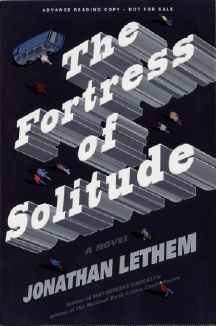 Fortress of Solitude, Jonathon Lethem One of the more brilliant novels to fall into my hands recently, but this loses its glittering attraction towards the end by eschewing explorations of the 1970's Brooklyn tagging and hip-hop culture for the personal trauma of growing up white in a black neighborhood. Though disappointed by the ultimate direction of this novel, it'd be foolish not to recognize how Lethem has made the area of racial tensions and its contribution to pop culture his particular area for mining anecdotal recalls from the very recent modern.
He builds up a plot around the shared mutual love of DC Comics, hip hop and robbing spray paint between two boys, one white, one black. That these two kids would take such dramatically different paths in life is an testament to the strength of racial separation in the states today, despite the mainstream acceptance of predominantly black cultures. Brooklyn breathes all over this book, you can be of no doubt that Lethem was inhaling its air as he produced the detailed accounts of building gentrifaction beginning with the '60's counter culture and then how crack first began to take hold in the projects.
History of Argentina in the 20th Century, Luis Alberto Romero Going by the Evita Museum and others in Buenos Aires, after the dictatorship came to power - it without reason dug up the first lady of the Peronista movement's corpse. The gaps between what most national history museums tell you and the reality of a country's politics is the reason you rush out and buy a book like this to fill in the blanks yourself. Romero has produced a book that does extraordinarily well on the undergraduate circle, its constant status as an instant reprint has led to more recent updates to cover the dramatic neo-liberal restructuring under Carlos Menem and the more recent uprisings from 2001 on.
Basically its a dry, academic history of Argentinian presidencies and their economic polices, the complexity of social movements are really only explored when they pierce out of and briefly push aside state hegemony as in the late 1960's and again in the late '80's and 2001. Though for an account of the social movements readers are best pushed off to reading the contemporary accounts the author himself will likely end up relying on for future updates. Romero successfully manages to give the new comer a grounding in the emergence of Argentina as a distinctly European South American city, his coverage of the Juan and Evita Peron movement, which in itself stands as a good basis for moving on to other periods while the corruption within the ruling elites is pleasantly left wide open for consumption.
 Wild Swans, Jung Chang This piece of history from below has probably sat on most book shelves since the mid-1990's, when it first had accolade after accolade thrown on it for its emotional detailing of the lives of three daughters of China. Its brick shaped size has put many off, but don't be afraid. What Chang has managed to do is create a highly engrossing account of three periods in Chinese history, from the period of war lords and Japanese occupation, right through to the civil war between the nationalist Kuomintang and the communists and then the most dramatic period of all under the stewardship of Mao and the cultural revolution.
At its best Wild Swans details the effect different forms of political hegemony had on the internal life world of the Chang family. The most astute renderings are the descriptions of the lives of women during the three periods, from the concubine existence of her grandmother and her struggle against it to her own mothers development as a communist as a slap in the face to the reactionary feudal system and its prescriptions on women. Wild Swans is a fantastic entry point to Chinese history, but the author's bleeding heart eventually becomes tiresome as you realize the gap between her parents sufferings and her own privileges.
 My Century, Gunter Grass There's a name that rings familiar, you associate it with terms like "intellectual tour de-force" or the obscurities of German left-wing writers. A lot is riding on it when you come across one of his books for the first time. My Century is an unusual novel, it rolls through what Eric Hobsbawn called "the century of extremes" in a series of personal tales told by 100 different voices for 100 different years. The years of the Great War are recalled by the hunched over authors of several war classics from a perch of four decades later, while the twenties and thirties are marked by the social crisis of German society between the struggling forces of Communism and the fascist response to working class organization.
Overall as this landslide of voices tumble down around you Grass presents a multi-faceted, overview of the complex questions that feed into the construction of contemporary German national identity which dominates the novel from the 1960's on and emerges strongly again in the era of re-unifaction. To be honest, that Grass received the 1999 Noble Prize for literature for this novel says more about the pre-millennial love for count downs than his writing talent.
Labels: Irvine Welsh, Literature, South America, Travel
(0) comments
Wednesday, January 03, 2007
Memories of the 'Dirty War' Reawakened in Argentina
 The disappearance of Julio Lopez, an aging former political prisoner and important state witness in the trial of a former police investigator found guilty of human rights abuses electrified the social movement in Argentina back in November. Despite mobilisations and the appearance of graffiti demanding action from the Kirchner government all over the capital, there are now further hints of present day dirty tactics by police connected to the former dictatership. On the same day that Spain resolved to arrest former police officer and alleged death squad leader Rodolfo Almiro, a second disappeared witness in trials against military officers - Luis Angel Gerez - suddenly reappeared. This reappearance comes amidst widespread claims that hundreds of threats have been made against human rights and social movement activists in the capital and across the country, as usual Upsidedownworld.org has the latest...
Labels: Argentina, Politics, Social Movements, South America
(0) comments
Wednesday, November 29, 2006
Bolvian Land Reform: La Paz´s Streets Become A Theatre of Power.
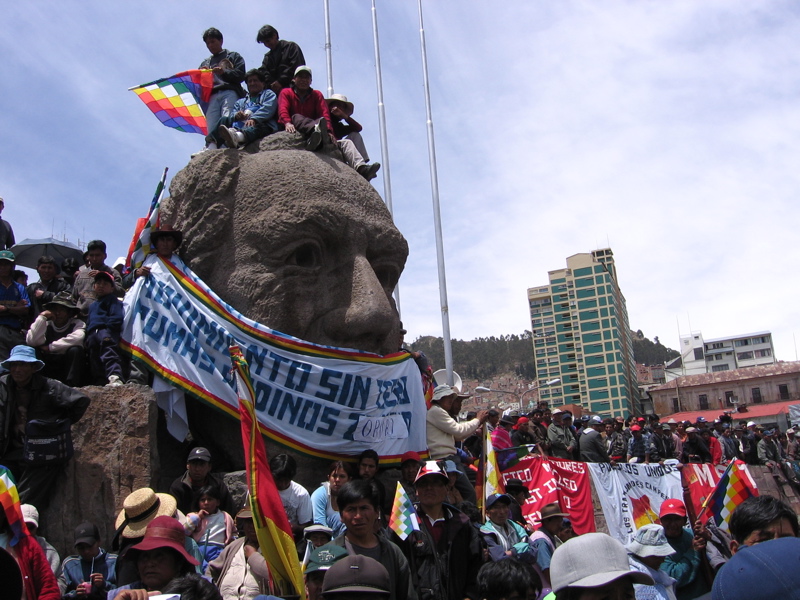 Hurriedly returning from negotiations with the Shell executive in Holland, Evo Morales last night granted accesion to a law of agrarian reform leading many of La Paz´s morning tabloids to carry headlines claiming he had declared war on the latifundia dominating the country's system of land distribution. In the other Bolivia of Santa Cruz and Beni, regions dominating 80% of the Bolvian economy, as little as 14 families hold over 3m hectares of unproductive grounds in their hands. This new land reform facilitates removing this land from idle hands and redistributing it to campesinos, similar perhaps to legislation facilitating the placing of unproductive factories into the hands of workers in Argentina.
 Bolivian dymedia carries a series of photos from the assembled organisations of the indigenous supported by urban based trade union federations as they were addressed by Morales in the Plaza de San Francisco. After the speech the crowd split with some marching towards a university building where students greeted them with a banner drop from the roof saluting their struggle, before providing some food and refreshment. A smaller contingent went straight towards the parlimentary buildings in around Plaza Murillo, carrying traditional Aymara wiphala flags and marching in regional contingents under the banners of the MST (Movement Without Land) and other indigenous national organisations.
Most of these organisations regrouped later in the evening and from the same square oversaw the actions of the senate late into the night. Eventually Morales signed the law into effect in his characteristic casual wear of a leather jacket with some woven artisan touches. Beeping cars greeted the cheers of campesinos across the city as the Bolivian National TV service chimed in on the historical significance of the day that passed, while its cameras panned in on banners of the agrarian struggle strewn over the balconies of the senate's public gallery.
The vigilance around the senate was convened yesterday alongside the demonstration earlier by the MAS (Movement Towards Socialism). In the past week Bolivia has been captivated by what parts of the press have called a "social crisis" with others sensationally and hysterically pointing towards a civil war. Members and supporters of right wing parties have gone on a hunger strike led being led by the owner of Bolivia's Burger King franchise in opposition to the reforms being pushed by the MAStistas. Last week more seriously witnessed a large demonstration in right wing strong hold Santa Cruz, an event surrounded by a dangerously developing discussion on seeking autonomy from the MAS parliament. Santa Cruz is where the main private media is located and also not surprisingly where the oligarchs and their wealth are largely concentrated.
More immediately grevious from the point of view of passing the land reform act was the boycott called by opposition parties in an effort to undermine the quorum required to pass the act. On Monday campesinos that had surrounded a meeting of dissenting non-MAS regional prefects in Cochabamba were gassed by police and attacked by a youth organisation related to one of the right wing parties. MAS is clear on the need for more excercises of power in the streets in opposition to the moves of the right, "if the marches put order in the Senate, now it is necessary to put order in the Constituent Assembly." The Constituent Assembly is where the Bolivian constitution will be subject to a process of revision and rewriting, a process open to potential frustration by the political right. This is why the streets are important. The mobilised mass expression of political will on the streets has been where power has lay in recent Bolivian history, evidenced in the Water War and right up to the Gas War that brought Morales to power.
Despite the street theatrics of yesterday Morales insists his party the MAS is a state based legislating instrument of the social movements from which it seeks sanction for its political reforms. This was reflected in comments yesterday outside the historic Fransican monestry in the centre of La Paz, when he described how "legally, constitutionally, we will end the large estate. We will not take by the force earth but with the law in the hand." Some obsevers however have commentedthat the recent electoral success of MAS has forced closure in social movement debates in Bolivia on paths to revolution less reliant on the state as a lever of change. Prominent in these critiques is the view that the legislation used to convoke a constituent assembly has re-legitimised the role of right wing parties, something torn away from them in recent popular uprisings. As a form of representative democracy this law also removes any possiblity for the direct representation of social movements in the process of re-drawing the constitution leaving them instead to jockey for position with MAS in an increasingly cliental based politics.
Going back to the Rossport Solidarity Camp gathering in June on Indymedia readers can find an interesting interview with Jose Sagarnaga, from La Paz in Bolivia, who is active in the London based Bolivia Solidarity Campaign. Two blogs both taking their names from Eduardo Galeano and worthy of note for their coverage of where power and social movements clash in Latin America are Upsidedownworld and Openveins. Pay attention to both of them for more.
First published over on Indymedia.ieLabels: Bolivia, Indymedia, La Paz, Politics, Social Movements, South America
(0) comments
Friday, October 06, 2006
Book Launch: Clandestines: the Pirate journals of an Irish Exile
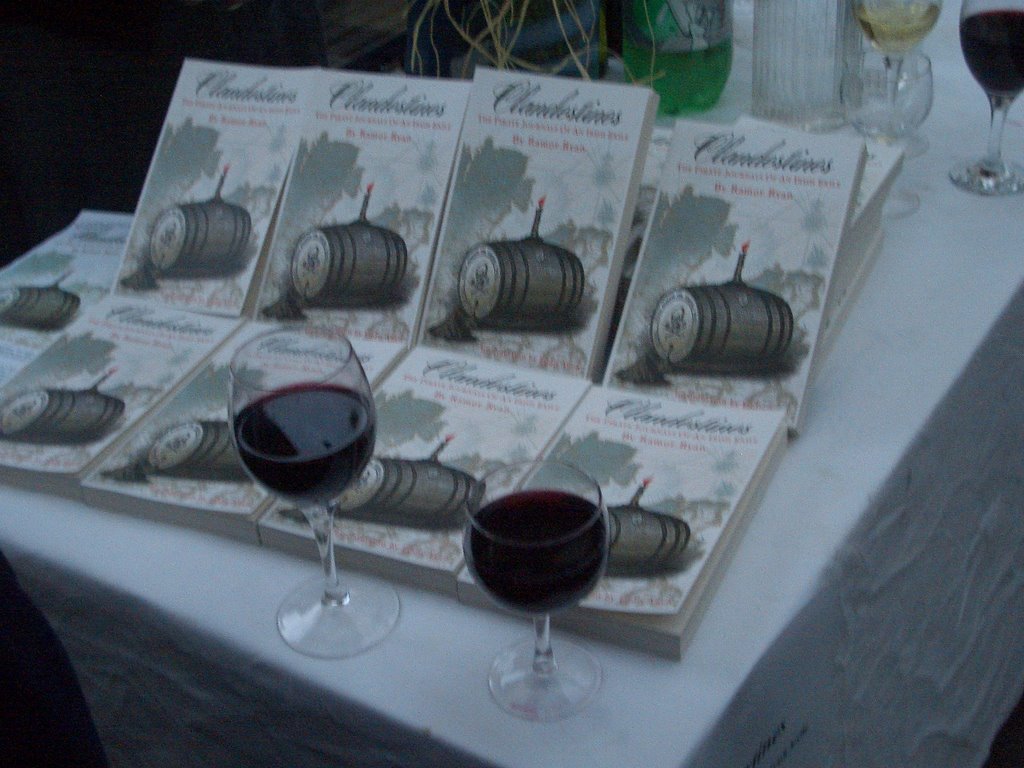 Over the past number of years there has been an emergent cannon of anti-capitalist literature providing polemic and analysis aimed at undermining the comfort zones of late capitalism with ripostes from its rebellious borderlands. This literature verges between two forms. There is the sometimes arid academic style shaping tomes on anti-capitalism as a new social movement. Then there are other compendiums that collate smaller pieces from the movement themselves in collections that inevitably end up sitting on undergrad reading lists or bookshop shelves in easy reach of a broader audience.
This is a very Irish book in one way, written by an exiled anarchist faced with immigration who opted for global political hot spots over the building sites of London or the dole queues of Dublin. The Temple Bar Gallery in Dublin played host last night to a book launch marking the latest addition to this world of anti-capitalist imagination. Ryan's Clandestines: the Pirate journals of an Irish Exile seems to be a book that infuses a stringent lived passion for revolutionary change with his own broad theoretical sweeps and political musings. In this way it clearly echoes the whimsical mental and physical travels of Naomi Klien's Fences and Windows, but takes a far more personal and biographical tone. From quickly glancing over it, Cladestines is composed of a series of easily digestable vignettes taking the reader from the squat scene of East Berlin, to armed struggle in Kurdistan and an eyewitness account of Michael Stone's murderous rampage at a republican funeral in '88. These primary tales represent the formative years in Ryan's growth, but are quickly eclipsed by his journeys in the new world of South American radicalism. The blurb on the back describes the novel as a Che like travelogue dripped in the sped up flair of Hunter S. Thompon's gonzo adventures and as such is one definitely worth adding to the reading list.
Unlikely to recieve much of a popular release, Ramor Ryan's Clandestines: the Pirate journals of an Irish Exile will be on sale in Anthology Books in Temple Bar and directly from AK. There will also be a reading from the book by Ramor courtesy of the Trinity Anarchist Society entitled From the Berlin Blacbloc to Zapatista Zones, it starts at 7:30pm on Wednesday, October 19th in room 4050b.
Links to some more of Ramor's Writings: We Are Everywhere | Confronting Capitalism | Days of Horror Nights Of War | More online pieces | Longer online review by a WSM comrade
Labels: Indymedia, Literature, Ramor Ryan, Social Movements, South America
(0) comments
Saturday, January 03, 2004
Interview: Chilean Student Activist On Educational Reform
What sort of issues do students face in Chile?
Well, the biggest issue is the problem of privatisation. Secondly you have the problem of repression as well, there is a lot of repression against the student movement that tries to organise and fight back against the privatisation measures. That of course is a situation that comes out of the time of the dictatorship, from the reform of 1980 when there was a big cutback in education to allow the private sector to start investing more.
So you say 1980 was a period of intensive cutbacks to force privatisation, that appears quite similar to what the Irish state are doing now, what sort of reforms were brought in back in Chile?
In the University of Chile where I was studying, just 30% of the income is public sector, 70% comes from the private including fees, so that gives you an idea of how important the private sector is in education in Chile and how much of a business is as well. Of course all that happened through forced measures under the dictatorship when the mass movement had many other tasks to face as well. So I think in Ireland you are in a better position to fight it off because you don’t have such a repressive context in which you have to face military rule.
You say repression as well as privatisation is an issue facing the student movement in Chile, what exactly do you mean?
Well, you’re talking about a very subtle repression in some ways. Most of the academics were appointed under military rule, they got to university that way and they reproduce the same kind of people in the academy. Academics tend to be very right wing and the student movement tends to be very left wing. The most obvious form of repression is police repression. Every student march will finish with water cannon, with a number of students in prison with batterings, students in hospital; it’s really bad on that point as well. Every student march is the same, loads of tear gas, loads of riot sticks, it’s always the same.
So how does the student movement organise?
Well it’s basically organised through student federations and student unions, some federations are more militant than others, some have more rank and file organisations than others, you have federations that are in the hands of the right, some are strongholds of the left.
What sort of tactics have the Chilean students’ movement found to be most effective?
It varies from federation to federation, from students’ union to students’ union. Of course the most effective tactic is direct action, and of course I am an advocate of that, but there is always a tension between groups, we are always demanding rank and file action, real measures of pressure with struggle, and then there are those that are fond of lobbying. The right-wingers don’t really privilege any tactics, they just want the student union to organise football matches and stuff like that.
How does the student movement link in with other sectors?
Well, student movements in Chile have never been isolated, they have always played a very active role and been active participants in politics in general, both in reactionary politics and revolutionary politics, but the student movement has always been leaning to the left as a general trend and there’s always been historical links with the working class that go back to the beginning of the twentieth century. Actually the student movement was built on the revolutionary unions that at that time were all illegal and they were born as means of direct struggle and points where the working class met with students in the struggle for a better society, so that link always existed.
At the moment Ireland is witnessing a trend of neo-liberal reform, with a push being made for privatisation in education, transport and other sectors. Chile under military rule was a playground where these ideological models were played out first, leading some economists to claim there was an ‘economic miracle’, what do you think of neo-liberal reform in the public sector?
Well, Chile’s the best example that it’s not working. If you look at the distribution of income, if you look at the quality of public services, it’s appalling. There has been the rise of an elite, where only the privileged sectors of society have access to third level education. But the working class find it more and more difficult as each day passes. Not only access to education has been affected, it affects the whole education system. The wages of teachers get affected, so teachers have to work outside education as well, so university becomes more a burden for them than a real job, where they can dedicate real time. There are many problems where labs are in decline, research is in decline, there is a concentration of research. It affects education at all levels, we had very good top research, and it’s all gone in twenty years of neo-liberal reform.
If you are of the privileged, of course it’s a brilliant economic miracle. Of course if I’m getting richer, I’d tell all the world. But if you are working class, and are obliged to work twelve hours a day legally, if you have no rights at all and have been systematically abused under the administration, if you know your offspring have no hope of going to third level and are always queuing for crap public health, you will find it pretty tough to talk about an economic miracle. It all depends on what side are you on, it’s all class struggle.
What advice would you offer the student movement in Ireland?
Oppose fees at all costs, because it will rot the whole education system. If education goes down, society in general goes down, research, even life expectancy. But the most important thing is to understand that it’s an ideological battle, its not about whether you can afford fees, most Irish students don’t give a shit, most could afford the fees the state are offering, but the point is you can’t accept education as a commodity and not a right. It’s the most important thing, it’s a matter of principle not a matter of whether I can afford it. It’s a really different struggle, which can only be won if you really build links with the wider social movement, with the unions, with workers and their struggles.
Labels: Chile, Education, Interviews, Politics, South America
(0) comments
About Soundtracksforthem specialises in iconoclastic takes on culture, politics, and more shite from the underbelly of your keyboard. A still-born group blog with a recent surge of different contributers but mainly maintained by James R. Big up all the contributers and posse regardless of churn out rate: Kyle Browne, Reeuq, Cogsy, Chief, X-ie phader/Krossie, Howard Devoto, Dara, Ronan and Mark Furlong. Send your wishes and aspirations to antropheatgmail.com
Label Cluster
In no certain order...
Politics,
Guest Bloggers
Interviews,
Music,
Internet,
Guest Bloggers,
Travel,
Blogging,
TV,
Society,
Film,
Gig Reviews,
Art,
Media.
The Neverending Blogroll
A Womb Of Her Own
Arse End Of Ireland
BlissBlog
BBC One Music Blog
Blackdown Sound Boy
Buckfast For Breakfast
Customer Servitude
Counago & Spaves
C8
Candy PDF Mag
Guttabreakz
House is a Feeling
Homoludo
Infactah
Indymedia
Indie Hour Blog
Jim Carroll
kABooGIE MusIC
Kid Kameleon
Kick Magazine Toronto
Libcom
Matt Vinyl
Modern Cadence
Mongrel
Nialler9
One For The Road
Old Rotten Hat
Pitchfork
Salvo
Spannered
Sigla
Test
Thumped
Newish Journalism
TV Is Crying
Uncarved
Una Rocks
Urban75
Weareie
WSM
Wooster
Village Magazine
Radical Urban Theory
Archives
February 2002
October 2002
April 2003
September 2003
November 2003
December 2003
January 2004
February 2004
March 2004
June 2004
September 2004
January 2005
February 2005
March 2005
April 2005
June 2005
July 2005
August 2005
September 2005
October 2005
November 2005
December 2005
January 2006
February 2006
March 2006
April 2006
May 2006
June 2006
July 2006
August 2006
September 2006
October 2006
November 2006
December 2006
January 2007
February 2007
March 2007
April 2007
May 2007
June 2007
July 2007
August 2007
September 2007
October 2007
November 2007
December 2007
January 2008
February 2008
March 2008
Gig Review: The Fall Tripod
Gig Review: Gogol Bordello
Broken Pencil Gets It's Irish On
Fecking Civil Servents
Fake Pharma Ads
Vidiot: Data Entry
Life and Debt
Last Night Cosmo Baker Saved My Life / Hip Hop His...
Eye Candy: Dufferin Hoarding Gallery
Review: Heads for the heart of the Sun – The Welco...