
Friday, December 07, 2007
Bolivia: Social Movements On Fire.
 Over the weekend of November 24-25th, protesters clashed with police in Sucre, Bolivia - they were demanding that the capital of be moved there. Three people died and over some 100 were wounded in the clashes. Yesterday Morales announced plans for a nationwide referendum to resolve a deepening political crisis in the country. A few months ago, two recent works on Bolivia were given a look over for the WSM's Red and Black Revoltuion 14, the review appeared on Indymedia.ie first and here it is for you blog readers
A few years ago the Cochabamba water war coincided perfectly with the 2000 anti-globalisation peak to solidify many of that movement's arguments about neo-liberal rule in cold hard scenarios of struggle. An exciting new round of images depicting indigenous women confronting militarised police dotted left publications, while documentaries like 'The Corporation' used the revolt as a sharp anecdote in hacking off the avaricious tentacles of multinationals.
A review of "The Price of Fire" by Ben Dangl and "Impasse In Bolivia" by Benjamin Kohl and Linda Farthing.
With the success of the Movimiento al Socialismo (1), western attention moved from the social movements honed in such resource struggles to the left caudillo Morales and, despite previous excited flutters, there's now little comment on how the grassroots relate to this new moment.
Al Giordano complained in a recent book on Oaxacca, that the radical press often shares problems with the mainstream - reeling in a journalism of instant replays, full of heroic and tragic moments from the barricades, instead of cogent analysis.
Thankfully in the past six months two very different books sought to pierce through the frailty of movement reportage on social movements in Bolivia, to explore why they emerged with such force since the 1990's and how they now relate to the MAS.
The first of these is Kohl and Farthing's 'Impasse in Bolivia', a heavily wrought background to the face off between a globally prescribed neo-liberal hegemony and a local population repeatedly drawing on a five hundred year resistance narrative.
Taking the reader through a well-elucidated history from the Spanish Conquest to the early 21st Century, they track how economic restructurings affected the composition of Bolivian resistance movements prior to neo-liberalism.
The exploitation of silver deposits at Potosi by the Spanish profoundly re-organised Andean society, leading to the emergence of indigenous resistance through nested kinship structures that fuelled rebellions such as the mythic 1781 siege of La Paz from the alti-plano by tens of thousands of Aymara warriors.
The authors describe how the later drive for an independent Bolivia stemmed from liberal criollos keen for the benefits of their own state but bent on uprooting and modernising indigenous communal land-holding systems to fundamentally exclude them as citizens.
The eventual replacement of these hacienda based elites with natural resource companies at state level set the ground for embryonic industrial agitation and ripples that reach the present.
In the thirties a rivalry between Standard Oil and Royal Dutch Shell over control of deposits in the Chaco region forced Bolivia into a proxy war with Paraguay for control of the disputed area. Defeat both drastically reduced the country's land mass and welded the social force for the 1952 Revolution among war weary drafted students, workers and campesinos.
The resultant Movimineto Nacional Revolucionaro deposed the mining oligarchies with a regime subject to land and labour pressure from below in the form of the Confederacion Obera Bolivian. Forced to recognise land seizures and labour demands, it constructed a state in the modernist nationalist tradition with a strong central administration and control over natural resources.
This defiant union movement continued to push for a deepening of citizenship rights only to be marshalled with a military dictatorship in 1964 as Cold War realities hit home.
The imposition of neo-liberal economics in the eighties under the NEP against this historic background becomes quite central to the authors' account, seen as a serious attack both on what became known as the "State of '52" and the labour movement.
Engineered for president Estenssoro by Jeffery Sachs of the IMF, it was the first programme of its kind, leading to some economic recovery in the face of hyper-inflation but an ensuing human misery.
Over 20,000 miners lost their jobs, manufacturing collapsed and over two thirds of the urban population were dragged into the informal economy, dramatically paralysing the COB as the backbone to popular struggles.
With the way paved for an affirmation of neo-liberal policies, Gonzalo Sanchez de Lozada's Plan de Todos in the nineties unfolded with the familiar theme of privatised state owned enterprises, gutting the country's revenue.
Yet according to the authors, the couching of this new market democracy in electoral and social reforms inadvertently opened a space for indigenous resistance in rural areas.
As failed neo-liberal promises bolstered anger, diverse movements around coca eradication in Chapare, land rights and basic urban services quickly transformed the political landscape to "forge a common sense of injured national identity (2)."
Unfortunately Kohl and Farthing's work is hamstrung with the distance of academia, it sketches the imposition of neo-liberalism brilliantly but fails to illustrate "the shape that popular challenges to it will take (3)" in any grounded way.
Using a very different approach Benjamin Dangl's 'The Price Of Fire' is refreshingly intimate, he too starts with a "revolution in reverse," rolling through the tides of Bolivian revolt during a brief stay in old Potosi.
His writing style is steeped in hauntology and the psychic scars of centuries of exploitation; it's the fruit of bar room conversations, pickets and blockades and a brief encounter with Morales. He cushions this in minor analysis and travelogue, allowing voices from social movements to provide a "human face to the looting and struggles of a continent (4)."
During a visit to the Chapare, this "bearded gringo with a notepad" rails against the use of coca eradication as a paltry excuse for US intervention in the post cold-war climate, arguing that the migration of unemployed miners to rural areas accelerated coca's growth as the only viable cash crop under neo-liberalism.
From this dynamic the MAS emerged, capable of unifying different strands of struggle with its origins in coca growers' unions formed by former miners. Visually this is seen in the use of the coca leaf as party insignia, once used for energy by silver miners but equally evocative of indigenous and anti-imperialist messages today.
The book continuously traces how modes of militancy spread through migration. Like Farthing and Kohl, he agrees that the water war was a momentous turning point with the practice of mass assemblies in rural areas becoming more engrained in cities through the Coordinadora.
Retaining a critical eye, he doesn't rush to romanticise the end result of the water war. Bechtel may have left but the public water company is still controlled by a local political elite, though one more subject to street based popular power.
The question of how to use Bolivian gas further unified traditionally diverse social movements in the 2003 gas war to reverse the privatisation carried out in the mid-nineties. Protesters used "the wealth underground" as a point of correction for past lost resources and to envision a future of possible development, education and health-care.
Casting his eye to Caracas, Dangl hints at the use of oil revenue in Venezuela to empower the nation's poor with literacy programmes, health clinics and community centres as a path for the Morales regime.
'The Price of Fire' takes a brief jaunt into urban geography in a chapter on the internal world of the El Alto, a city whose residents played a crucial role in the 2003 gas revolt. The same social forces that drove miners to become cocaleros in rural Chapare led to the informal settlements outside La Paz skyrocketing to a population of 800,000.
Neighbourhood organisations sufficiently ingrained to strangle the capital below in periods of struggle, sprung up based on the experience of miner and rural agitation, as well as the absence of basic state services. One of the few academics Dangl speaks with describes their strength as lying in "the basic self-organisation that fills every pore of the society and has made superfluous many forms of representation (5)."
Within these El Alto urban movements we are given glimpses of a counter-cultural response to neo-liberal hegemony in Teatro Trono, a theatre group meshing struggles against the IMF with traditional myths in popular education programmes. There's also a growing hip-hop movement that fuses the Aymara language with sampled stateside beats into a poetics of urban resistance to poverty.
In his conclusion Dangl takes a critical look at the problem fraught Morales' regime. He claims that images of troops entering gas fields from afar look like the stuff of radical expropriation but nationalisation really meant a series of buy outs of majority stakes sold for a pittance in the 1990s, higher taxes and a re-negotiation of over generous contracts.
Stepping aside from the flurry of rhetoric surrounding nationalisation, the YPFB in reality still remains at a capital disadvantage with international companies holding minority shares.
Rarely mentioned in discussions of Bolivian social movements is the traditional demand for a constituent assembly convoked by Morales this year. Many of the movement activists we meet through Dangl's travels complain that the electoral nature of the assembly excludes them, forcing them to abandon their autonomy and seek representation through the MAS party.
Simultaneously it has reinvigorated right wing parties weakened by the popular rebellions, allowing them the space to develop a dangerous language of autonomy for oligarchical strong holds like Santa Cruz.
If you are looking for long streams of statistics on Bolivia's immiseration, then Farthing and Kohl have compiled a resource for your agitational pot-shots and filler articles - but if you want the human face of Bolivia's social movement push, then Dangl is your only man.
Whichever you prefer, Bolivia remains a fertile soil for the rebellious imagination, full of "better worlds- some that have lasted and some no more than euphoric glimpses (6)."
(1) Movimiento al Socialismo (Movement Towards Socialism) is the party of Evo Morales.
(2) Kohl, Benjamin and Linda C. Farthing. Impasse in Bolivia: Neoliberal Hegemony and Popular Resistance (Zed Books, 2006) p175
(3) Ibid p23
(4) Dangl, Benjamin. The Price of Fire: Resource Wars and Social Movements in Boliva (AK Press, 2007) p11
(5) Ibid p151
(6) Ibid p9
Check out Upsidedownworld for an analysis of the latest tensions.
Labels: Bolivia, Literature, Politics, South America
(0) comments
Wednesday, November 29, 2006
Bolvian Land Reform: La Paz´s Streets Become A Theatre of Power.
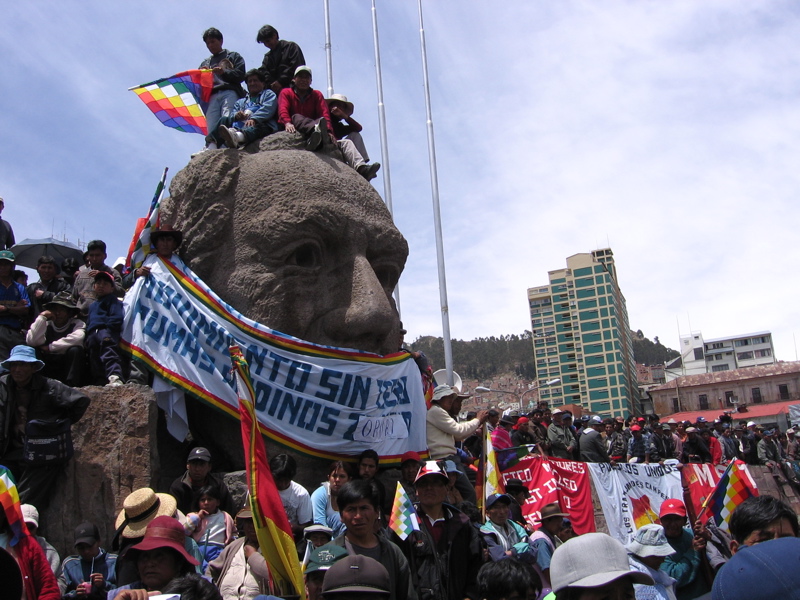 Hurriedly returning from negotiations with the Shell executive in Holland, Evo Morales last night granted accesion to a law of agrarian reform leading many of La Paz´s morning tabloids to carry headlines claiming he had declared war on the latifundia dominating the country's system of land distribution. In the other Bolivia of Santa Cruz and Beni, regions dominating 80% of the Bolvian economy, as little as 14 families hold over 3m hectares of unproductive grounds in their hands. This new land reform facilitates removing this land from idle hands and redistributing it to campesinos, similar perhaps to legislation facilitating the placing of unproductive factories into the hands of workers in Argentina.
 Bolivian dymedia carries a series of photos from the assembled organisations of the indigenous supported by urban based trade union federations as they were addressed by Morales in the Plaza de San Francisco. After the speech the crowd split with some marching towards a university building where students greeted them with a banner drop from the roof saluting their struggle, before providing some food and refreshment. A smaller contingent went straight towards the parlimentary buildings in around Plaza Murillo, carrying traditional Aymara wiphala flags and marching in regional contingents under the banners of the MST (Movement Without Land) and other indigenous national organisations.
Most of these organisations regrouped later in the evening and from the same square oversaw the actions of the senate late into the night. Eventually Morales signed the law into effect in his characteristic casual wear of a leather jacket with some woven artisan touches. Beeping cars greeted the cheers of campesinos across the city as the Bolivian National TV service chimed in on the historical significance of the day that passed, while its cameras panned in on banners of the agrarian struggle strewn over the balconies of the senate's public gallery.
The vigilance around the senate was convened yesterday alongside the demonstration earlier by the MAS (Movement Towards Socialism). In the past week Bolivia has been captivated by what parts of the press have called a "social crisis" with others sensationally and hysterically pointing towards a civil war. Members and supporters of right wing parties have gone on a hunger strike led being led by the owner of Bolivia's Burger King franchise in opposition to the reforms being pushed by the MAStistas. Last week more seriously witnessed a large demonstration in right wing strong hold Santa Cruz, an event surrounded by a dangerously developing discussion on seeking autonomy from the MAS parliament. Santa Cruz is where the main private media is located and also not surprisingly where the oligarchs and their wealth are largely concentrated.
More immediately grevious from the point of view of passing the land reform act was the boycott called by opposition parties in an effort to undermine the quorum required to pass the act. On Monday campesinos that had surrounded a meeting of dissenting non-MAS regional prefects in Cochabamba were gassed by police and attacked by a youth organisation related to one of the right wing parties. MAS is clear on the need for more excercises of power in the streets in opposition to the moves of the right, "if the marches put order in the Senate, now it is necessary to put order in the Constituent Assembly." The Constituent Assembly is where the Bolivian constitution will be subject to a process of revision and rewriting, a process open to potential frustration by the political right. This is why the streets are important. The mobilised mass expression of political will on the streets has been where power has lay in recent Bolivian history, evidenced in the Water War and right up to the Gas War that brought Morales to power.
Despite the street theatrics of yesterday Morales insists his party the MAS is a state based legislating instrument of the social movements from which it seeks sanction for its political reforms. This was reflected in comments yesterday outside the historic Fransican monestry in the centre of La Paz, when he described how "legally, constitutionally, we will end the large estate. We will not take by the force earth but with the law in the hand." Some obsevers however have commentedthat the recent electoral success of MAS has forced closure in social movement debates in Bolivia on paths to revolution less reliant on the state as a lever of change. Prominent in these critiques is the view that the legislation used to convoke a constituent assembly has re-legitimised the role of right wing parties, something torn away from them in recent popular uprisings. As a form of representative democracy this law also removes any possiblity for the direct representation of social movements in the process of re-drawing the constitution leaving them instead to jockey for position with MAS in an increasingly cliental based politics.
Going back to the Rossport Solidarity Camp gathering in June on Indymedia readers can find an interesting interview with Jose Sagarnaga, from La Paz in Bolivia, who is active in the London based Bolivia Solidarity Campaign. Two blogs both taking their names from Eduardo Galeano and worthy of note for their coverage of where power and social movements clash in Latin America are Upsidedownworld and Openveins. Pay attention to both of them for more.
First published over on Indymedia.ieLabels: Bolivia, Indymedia, La Paz, Politics, Social Movements, South America
(0) comments
About Soundtracksforthem specialises in iconoclastic takes on culture, politics, and more shite from the underbelly of your keyboard. A still-born group blog with a recent surge of different contributers but mainly maintained by James R. Big up all the contributers and posse regardless of churn out rate: Kyle Browne, Reeuq, Cogsy, Chief, X-ie phader/Krossie, Howard Devoto, Dara, Ronan and Mark Furlong. Send your wishes and aspirations to antropheatgmail.com
Label Cluster
In no certain order...
Politics,
Guest Bloggers
Interviews,
Music,
Internet,
Guest Bloggers,
Travel,
Blogging,
TV,
Society,
Film,
Gig Reviews,
Art,
Media.
The Neverending Blogroll
A Womb Of Her Own
Arse End Of Ireland
BlissBlog
BBC One Music Blog
Blackdown Sound Boy
Buckfast For Breakfast
Customer Servitude
Counago & Spaves
C8
Candy PDF Mag
Guttabreakz
House is a Feeling
Homoludo
Infactah
Indymedia
Indie Hour Blog
Jim Carroll
kABooGIE MusIC
Kid Kameleon
Kick Magazine Toronto
Libcom
Matt Vinyl
Modern Cadence
Mongrel
Nialler9
One For The Road
Old Rotten Hat
Pitchfork
Salvo
Spannered
Sigla
Test
Thumped
Newish Journalism
TV Is Crying
Uncarved
Una Rocks
Urban75
Weareie
WSM
Wooster
Village Magazine
Radical Urban Theory
Archives
February 2002
October 2002
April 2003
September 2003
November 2003
December 2003
January 2004
February 2004
March 2004
June 2004
September 2004
January 2005
February 2005
March 2005
April 2005
June 2005
July 2005
August 2005
September 2005
October 2005
November 2005
December 2005
January 2006
February 2006
March 2006
April 2006
May 2006
June 2006
July 2006
August 2006
September 2006
October 2006
November 2006
December 2006
January 2007
February 2007
March 2007
April 2007
May 2007
June 2007
July 2007
August 2007
September 2007
October 2007
November 2007
December 2007
January 2008
February 2008
March 2008
Gig Review: The Fall Tripod
Gig Review: Gogol Bordello
Broken Pencil Gets It's Irish On
Fecking Civil Servents
Fake Pharma Ads
Vidiot: Data Entry
Life and Debt
Last Night Cosmo Baker Saved My Life / Hip Hop His...
Eye Candy: Dufferin Hoarding Gallery
Review: Heads for the heart of the Sun – The Welco...