
Thursday, November 22, 2007
Avi Lewis On Occupied Factory Movement In Argentina: "This phase is less overtly political, certainly less overtly revolutionary."
 Anyone living in Toronto, a city with sidewalks wheat-pasted wildly with posters knows this; the Brunswick Theatre is creating an extraordinary space in a city bereft of places to engage with cinema. Regular discussions and talks happen, with documentaries sharply matched to a purpose rooted in popular education. If there is a criticism, it's that ticket prices are pretty steep. Last night's Avi Lewis lecture cost 15 dollars, but running a cinema at the location and with the frequency they do can't come cheap.
The poster for this screening foregrounded Lewis' public lecture, so at the start a moment was taken to see if watching the movie was actually worth while. Just over half of the raised hands had already seen the 2004 documentary that follows the fortunes of workers in the Forja auto plant as they struggle to turn it into a worker cooperative, yet the organisers ploughed ahead as planned. Using it to give ground the inevitable more abstract discussion to follow in human insight to the recuperated factories movement.
The night also doubled as something of a launch for Haymarket Book's translation of Sin Patron, a collection of interviews with participants in the recuperated factory movement. Lewis called this "a living document in the words of the workers themselves with an absurdly, provocative and piercing analysis by the Lavaca collective." A second edition is coming out soon with updates from some of the 160 something factories and workplaces indexed at the back of the present edition.
Shortly into The Take, there's a montage of boorish interviewers throwing demands for alternatives at Klein, so she explains the purpose of the movie as a search for alternatives outside the model of neo-liberal development. On the night Lewis glanced back at The Take as a glimpse of a moment in very recent social history, where large swathes of people realised "that changing pieces on the chessboard is not really changing the game." This bursting of the ideological bubble in a country where even the street signs were brought to you by Mastercard under Menem needs a closer look now that Argentina has largely stabilised, again "in the grips of a capitalist dream, where Kirchner does a good job of railing against the IMF, a bit like the NDP here, yet governs to strict IMF rules."
After the film with attention rapt for updates since it was made, the most pertinent question as Lewis saw it was more abstract: "is there a memory of struggle there, just beneath the surface? Is there a strengthened social movement that has built real bases in the communities and the workplaces?" The tone of his voice suggested a very optimistic "yes."
He'd just spent an hour and a half talking to somebody who works with This Working World in Argentina prior to this Brunswick talk, so Lewis was able to give some decent updates on the state of play in the factory movement at the moment: "this phase is less overtly political, certainly less overtly revolutionary as it deals with the nuts and bolts of making sustainable businesses work."
A friend of Zannon's ex-owner, who appears in the film as a cliche of bourgeois vampirism with the champagne bottle lurking in an ice bucket in his opulent office, recently used his position of governor of the province to run for president. The discourse he used in his campaign was largely a return to the language of the dictatorship, but he got less than 1% of the recent vote. Zannon under workers control now employs 480 people and provides more than the domestic demand for ceramics in Argentina.
On a visit to the Brukman suit factory that is dramatically re-occupied in the film, Lewis couldn't find anyone to talk to him, forcing him to comment that: "if there's a social movement or co-operative that doesn't need journalists; then you know its a success.
More recuperated businesses are coming on stream, including a landscape gardening co-op that works creating city parks. This sector tends to be controlled by Mafia type groups linked to Peronism so it was necessary to use political force for the city to sign a contract with them. Using the strictures created by the business practices of the previous operators, the new co-op was able to pull a massive scam loan legally to fund other co-ops in the region. A meat packing co-op has been set up that employs 800 people, a river boat casino is coming under workers control and the only balloon manufacturer in Buenos Aires is under workers control and supplies the whole province.
On a bleaker note many of the recuperated factories and businesses will be facing new difficulties as the legal system allows only a two year term of expropriation. With workers successfully turning failed businesses around, the bosses may try coming in through the back door of the courts leading to hazards ahead. The balloon co-op for instance may have to up stakes and use its capital to open elsewhere. For a movement that has concentrated so much effort on carving out spaces of dialog and popular education with communities, this geographic displacement may well blunt part of their projects, leaving them more easily prey to future evictions.
Labels: Argentina, Class, Film, Politics, South America
(0) comments
Tuesday, November 20, 2007
Book Review: The Rebel Sell
 Joseph Heath and Andrew Potter The Rebel Sell: Why the Culture Can’t Be Jammed (Harper Collins, 2004)
The Rebel Sell authors set themselves the task of attacking an idea of counter culture they see at the heart of social movements, so is that why the cover has a summit protester in gun sight?
Potter and Heath are right that counter cultural rebellion can sometimes suck energy away from making "concrete improvements in people's lives," providing excuses for not engaging mass society but their counter cultural imagination is limited to MTV, Adbusters, a host of mainstream Hollywood movies, the authors' own dashed ex-punk background, Kurt Cobain 's suicide notes and anything mall rat in between.
Despite their stated central preoccupation they ignore well articulated differences between “sub cultures” and “counter cultures.” You see sub cultures hang under the mainstream's belly, dependent on it and lacking a real critique. Counter cultures at least try to foster alternative values and ways of being to replace a dominant culture - so one contains at least some revolutionary purpose, the other doesn't. This failure to distinguish gives the authors an easy job of ripping into a series of piss poor straw men.
There is no discussion of the very real and needed role of counter cultural forms in political movements. How could they have overlooked the IWW's folk song tradition, the working man's clubs of the UK and Ireland or the foot ball leagues and community groups of pre-Nazi German social democracy - were these too just "pseudo rebellions" to be ignored?
Alongside historic blind sight, they completely skip the well trod over subjective reasons for engagement in counter cultures. Still note how an awful lot of school yard bullying stopped once they and their nerdy friends went punk. Counter cultures can be a very ordinary thing, a form of self defence or demarcation of space. Think of struggles around silly work uniform rules or piss ant fussy supervisors having their authority eroded by a shop floor black humor.
Really the book does contain some great pop culture writing, but the attempt to weave it into a general theory of counter culture falls a little flat even if their reason for writing it comes from a decent impulse: movements that define themselves by being on the margins of society, will stay there.
Much of the weight of their book is just a re-hash of Thomas Frank's quip that "ever since the 1960's hip has been the native tongue of advertising." The authors claim to "shatter central myths" turns out to be just restating the obvious with much weaker conclusions. They themselves do not want to "eliminate the game, but level the playing field" and so call for traditional social democratic measures to over come market failures. They even suggest bans on cosmetic surgery, ignoring how thwarted society really is by contemporary forms of alienation in their call for a rewind to the '50's.
Face it anything that opens with the claim that Adbusters selling Blackspot sneakers was a “turning point for western civilization” is bound to piss you off along the way. With sky scrapers of argumentation erected on foundations of sand, the Rebel Sell smacks of a pair of grad student academic enfant terribles - the perfect stuff for drunken conversations, mindlessly frustrating yet deeply challenging to your own steadfast opinion.
CHECK EM OUT>> Adam Curtis’ documentary The Century of the Self (on google video..) which looks at the harnessing of new lifestyles created in the 1960’s to brands that sell dreams over products and Thomas Frank’s book The Conquest of Cool, the original political economy of hip.
Labels: Class, counter culture, Literature, Politics, rebel sell, Society
(0) comments
Tuesday, November 13, 2007
Class Fictions: The Tale of A Factory Girl
 Whatever about those that hoot for the progress of history as if some grand design were at work, the working class of the nineteenth century were more than aware of what had been lost with the onset of the industrial revolution. As someone who had lived through some of the rougher years of hunger in 1840's Manchester - albeit removed from discomfort - Mary Gaskell produced her novel Mary Barton as a reaction, capturing a world with direct memories of the "pleasant mysteries" of a romanticised rural life abandoned for the urban where, as Engel's had it "the rapid extension of manufacture demanded hands."
 For a novel so remembered for its dealing with working class life, its stunning how little happens in the work place. The consequence of a middle class lady's inability to access factory life beyond a sociological or philanthropist basis, it could also be re-read as a striking concern about how the effects of work seep over into every day gossip, struggles and love - unwinding in manifold hidden injuries of class. It's through this space that Gaskell traces her tale of a love triangle, between a beautiful dress maker, a factory engineer and a masters son against the background of the second charter.
Gaskell's work is intertwined with the sociology of the day: best filtered down to us through works like Engel's The Condition of the Working Class in England but also in a plethora of titles like The White Slaves of England, Distress in Manchester and tonnes of government reports on factory conditions. Compare Engel's opening exaltation to the radical movement with Gaskell's introduction, and the tensions of her fear of new working class communities become clear. Aside from her main plot she strips Charterism to an atmosphere of hauntology bubbling in the background.
On the surface the novel hinges on a very private world interrupted by economic recession. Mary Barton tries to use her beauty to escape a classed faith through upward marriage. A missing aunt Esther returns as the "hooker with a heart of cold" to end themes whims, relating her own experience of where economics intersect with sexuality in a morality tale for the reader.
Crudely skim the surface of images and Barton's potential beau Henry Carson is very much the bourgeois vampire, sucking the life out of the living in the factories by day to fuel his life as a dandy at night. As her aunt Esther advises, she is best ignoring this sexual adventurer, who combines business and pleasure, to literally "screw" working class and settling for the simple childhood friend Jem.
Her father, the channel for the public world, is set on the path of murder and removed from the "the gentle humanities of the earth" once his wife dies, letting his "rabid politics" of Chartersim interfer with love interests that could naturally play themselves out. Gaskell's editorialises on the working of his mind steeped more in the criminology of her age, than the politics of striking workers like John Barton.
Ripped up and brought together in awkward patches of customs and commons by the new social forces of an advancing capitalism, a nod to Shelly's Frankenstien seems appropiate, but Gaskell as Raymond Williams noted, is more gripped by lurid fantasy than poetic reality in describing the Charterists as "a powerful monster, yet with out the means for peace and happiness ."
Whole subcultures of working class experience are ignored in Gaskell's pious treatment: drug abuse, petty theivery, sexual relations and alcohol are all filtered out through her religious lens. There is one glimpse of this as Jem sleuths around Esther's old haunts, discovering a rooming house where people bed down all day and roam the streets at night - the opposite of the work-a-day blues dominating the rest of the text. The gap left by the absence of the Manchester Irish is large too.
Her description of John's trade union meeting echoes her own work in gothic literary form, "strange faces of pale men, with dark glaring eyes peered into the inner darkness" - it's all disembodied beckoning hands, whispered desperate talk and ghostly voices murmouring through the floor boards. During the strike, a rough cartoon of starved strike leaders by Carson, is too sore an acknowledgement of the master's disdain, yet its very much a visual sketch of Barton's descriptive prose, and for John it is enough to justify murder against the masters.
The footnotes too are an ambiguous beveling of the text, they exoticise the voices within - making them more alien than they need appear, similar to Edgeworth's Rackrent and its treatment of the Irish peasantry. The tools of their life and trades are foreign to Gaskell - and she roots their slang in colloqialisms going back to Chaucer.
When John Barton returns from the delegation that delivered the second great petition, he grimly declines to tell "what happened when ye got to th' Parliment House" - any space is quickly subsumed to Job Leigh's vapid anecdote of his own trip there and back. From his perch as the self educated botanist he mediates through religious guff with Carson at the end for industrial optimism: "I'll never doubt that power looms and all such inventions are the gifts of god. I have lived long enough to see that it is part of his plan to send suffering to bring out a higher good."
This throw them all in the shit and let them sink or swim impulse of methodism chimes in perfect with the economic philosopy of Carson: "still facts have proved and are daily proving how much better it is for everyman to be independent of help and self-reliant." No wonder EP Thompson was driven to term it "a physic mastrabation" that was later replaced with the social Darwinism of consumerism as a new disciplining, secular religion for worker drones.
Ultimately she renders the working class as a useless parcel of the equation, a puzzle better left to a moral awaking in Manchester's masters than challenges to their rule. While she does develop a contrast between two ethical systems: that of the working class based on sharing and forced co-operation and that of the masters, based on ownership, authority and the law. Mary Barton is a good artifact of early capitalism, as Harry Cleaver noted she gives "various views of the beast in all its spiritual and fleshy reality."
This is most apparent in the journey to the Carson's house and the image of his tantrum stricken wife, bringing to mind Marx's comment that even the propertied classes share human self alienation but "feel comfortable and confirmed in this self alienation knowing that this alienation is its own power and possessing in it the semblance of a human existence." At leisure from work and need they are shown to place themselves in different dramas, the choice between this commodity or that, fractures of that social etiquettes or another.
Charterism was a dual moment, alongside a growing political voice through the vast networks of the unstamped radical press there was an aesthetic self-representation. Short stories, poems and accounts from within working communities from journo's like the work of Thomas Cooper (archived online...) . It's a pity one of the periods lasting literary impressions is the work of Elizabeth Gaskell, especially with her patronizing methodology to to "give utterance to the agony which from time to time convulses this dumb people" as she describes in the opening.
Labels: Class, Class Fictions, elizabeth gaskell, Literature, mary barton
(0) comments
Sunday, October 07, 2007
Class Fictions: What 30 Years of Pesto Stains Will Do To You.
 Toronto loves it's rubbish. It loves it so much it's hesitant to send any of it to the waste tip. Whereas we in Ireland throw consumer durables into the nearest skip or try hide them buried under food packaging for garbage day collection, Toronto breeds an informal economy of weekend garage sales.
What doesn't sell, finds its way into crumpling cardboard boxes with the label "free" attached. Overflowing mainly with unwanted books or magazines, they rest battered outside houses all over the city every weekend. Fodder for wandering book worms, the rooting curious or shopkeepers filling their second hand bargain bins.
They say you shouldn't judge a book by the cover. In these instances, more often than not, its precisely the cover and blurb that draws you in. Images and choice words that sketch unknown authors and titles - pushing your buttons of choice, however superficially.
Wedged in between omnipotent, always out of date geek tech manuals outside BMV was The Dishwashers. A compact play in two acts, by Vancouver based Morris Panych, it sold itself well. A Vice-esque cover with a certifiably Victorian dish washing unit cast in theatrical lights, suggested the dingy glow of a pouncy hotel's hidden basement innards and working life.
Fire on a back blurb attacking the contemporary fiction of the classless society, alongside the petty tyrannies of supervisors over their own miserable domains and at two dollars - bingo.
Panych throws his playwriting lens on the everyday hidden, the dream likes states of the "off stage" service industry. Silenced and treated as unreal, these are alien places where real life is suspended and a new "non-reality" begins - one with frightening and hidden consequences that often can not be woken from.
Using eleven scenes from the very temporal world of dish washing he sketches the frustration of "falling in the hole" of poorly paid and dirty jobs. That frustration is amplified if you are Emmet, once rich and then waking to find his wealth as "numbers on a chalk board erased." In a four man play he becomes that archetype of the worker "only passing through" and our means to meet those for whom dish washing is permanent.
Moss is a pitiful old crone, 90 years old and riddled with terminal cancer, in the job "since dish washing was invented" his work is an exoskeleton keeping his fragile sense of self alive - then he is fired.
Dressler is a supervisor and thirty years hot spraying pesto stained dishes has left him bitter. His muscles flex on minutia. He tears into any hints of a personality wanting to move away from sink and up the stairs that lead to the restaurant floor and by extension, the good life. He is tormented by the taunts of the social mobility myth: "if everybody was on the top of the heap, there wouldn't be a heap."
Emmet rushes into his kingdom of piled plates, bearing a banner of hope and class war vindictive - antagonising the survival strategies of those that have allowed themselves to wilt in the face of failed ambitions. Ultimately he is the one we should identify with but Panych is more subtle.
The pathetic Dressler is a cunt, driving himself on with spiteful critiques of his underlings and forensic examinations of the waste he sees on the plates he washes: "a fillet mignon with only one little bite out of it, and a cigar tuck into the smashed potatoes. Beautiful. What an extraordinary little monument to overindulgence."
But unlike Emmet, he is going no where so he has none of Emmet's naive faith in opportunity amidst economy based on manufactured tastes and distinctions: "people need to be led to these things; like slaves to the promised land. You don't go out in search of encrusted head cheese for fuck's sake."
Dressler also gets to deliver some of my favorite lines of late: ""democracy is a lazy bitch who never did a day's work in her entire life; then complained if after a late shift, you made too much noise coming home and dropping dead from exhaustion on the sofa."
Stick that down as your email signature. When Emmet does move on, he does so with a distaste that rubs itself in the face of those he leaves behind in the dishwashing basement, the sort of distaste that perpetuates the alienation he raged against while soaping up everyday.
Panych's latest production called Benevolence plays Toronto this month. Set in an old porn theater, on seats where exposed foam wrestles with exposed duck tape and the lives of a financial district dick and winter jacketed bum dangerously intertwine.
Despite Panych's concern for low paid service sector jobs with uncomfortable hours in The Dishwashers, Benevolence is a play I won't get to see - its over 35 dollars a ticket. Maybe I'll find it in a bargain bin some years down the line.
Labels: Class, Class Fictions, Literature, the dishwashers, Theatre
(0) comments
Friday, August 10, 2007
Vidiot: Call Centre The Movie
After starting a new job in a call centre I was pretty entertained to come across Call Centre The Movie, a short independent movie made I suppose, by some Indian Film makers - it strips away the telephone lines to look at life inside a fictional call centre in Delhi and the chaos that ensues when too many calls come in.
Driving along a similar vein I've recently added Chetan Bhagat's One Night @The Call Centre to my immediate reading list - it's the tale of a story told to a bunch of weary train passengers about romance, obsession and a phone call from God in another Indian call centre.
At the moment I am preparing a course on working class fiction for the Anarchist Free University in Toronto - you can expect a stream of posts on it - and am curious as to whether there is more fiction using call centres as a back drop, giving their massive role in the global economy at the moment - it'd be odd that fiction would ignore them, imagine a 19th century fiction without the mine and inner city poor. So I throw the floor open to you to fill me in, are there more out there?
Labels: anarchistu, call centres, Class, Film, Literature, Vidiot
(1) comments
Thursday, January 18, 2007
Organising Precarity In Ireland.
 As part of a special focus on precarity in the latest issue of Red and Black Revolution, the WSM has published an article I wrote nearly a year ago at this stage, on the experiences of the Get Up Stand Up Campaign and the Polish workers dispute in Tesco the summer before last. It kicks off a little something like this...
Labels: Class, Politics, Social Movements
(1) comments
Monday, October 09, 2006
Mindnumbing Muppet Number 7: Gillian Evans
 Presenting the latest in a series of Mind Numbing Muppets - a Soundtracksforthem response from the underbelly of the keyboard to the kaleidoscope of dazzlingly silly cahnts who impose themselves on us via their access to the media.
 Number 7: Gillian Evans
Gillian Evans is one of those ponitificating middle rank academics populating the society page of the Guardian with regular downbeat pop-tinged sociological observations on Britain's urban social ills. If she exemplifies anything it's that some mutant version of imperial anthropology was alive and well over at the Guardian last week as she sets out to discover what it means to live on a council estate. Gillian relates to her subjects with all the respect Coronation Street script writers imbue in stock comic characters like the Battersbys. Her subjects are a supposedly dwindling and arcane tribe called the working class, complete with their own peculiar atavistic practices and ancient social habits. Faced with a downscaling in her own economic situation, poor Gillian resolved to 'overcome [her] previous efforts to distance [herself] from the people' sharing her estate in order to research and study them in a rather vicious colonisaiton 0f class for academic career led purposes. The odd article appearing in that newspaper of the British chattering classes - the Guardian - is of course a handy bonus.
Her neighbour, Sharon becomes the arcetype of the working class house wife with whom the 'educated talk of the middle classes is useless,' so exhausted she is with the dull concerns of her drab working class life, opting instead to settle for the 'permanent joke of the body's sexual and excretory functions.' In Lady Gillian's eyes, the sign of how common you are is how much free time you allow your childern to play evoking all sorts of moral cacophony on feral childern and improper working class parenting leading to anti-social behaviour. Gillian revels in purposefully keeping her children seperate from those around her for fear of them contracting common practices. Gillian finally gets profound after a statement from one of her subjects that 'the secret of bein' working class is bein' 'appy with yer position.' In a classic imperial form the article ridicules the accents of its subjects, coming replete with excerpts bracketed in explanatory notes such as 'finkin' you're upper [better than other people].' It reeks of how Anglo Irish authors such as Maria Edgeworth attempted to drown the voice of their own sub-altern peasant opposities in footnotes and glossaries.
For Gillian this is a world where social class is an issue of the clothes you wear and the voice you bear, and as a result any resentment of assertion of a rich bashing dignity is dismissed as 'an inverse snobbery.' Not surprisingly after the publication of her book Gillian decided to feck off out of Bermondsey. Could you imagine the plight of her windows if she stayed? Oh wait Gillian was probably banking on the fact that her neighbours were too ignorant to read the Guardian.
Labels: Class, Gillian Evans, Media, Muppets
(0) comments
Friday, July 29, 2005
Polish Wildcat Strike In Dublin: Workers Refuse To Break Their Backs For Their Tesco Bosses
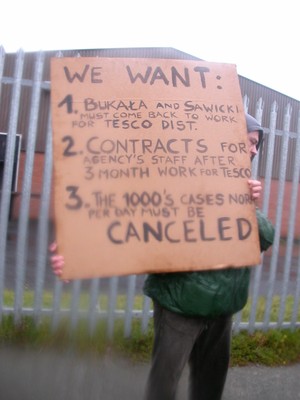 Two Polish workers who literally refused to break their backs for the boss in Tesco distribution have been fired. "Usually we pick 750 (boxes), but after three months of the normal rate our manager wants more, more, more . . . it's not possible picking 900. You must look after your back, and health and safety processes. If you pick 1,000 you'll break your back, you can not work like that." Work at first there seemed okay according to some of the Irish, but then Poland joined the EU and the company started to up the demands placed on workers in the centre as it started to hire Poles through a temp agency Grafton Recruitment.
The next time you're walking down Grafton Street keep an eye peeled for their poster. A young worker vaults over a pole - "Just how flexible do you want to be?" the poster asks - saying more about the insecurity of the modern work situation than any sociologist. "We have the interview every month and they say to us to pick up to 900 and a 1000. My manager told me I must pick up 130 cases an hour. It's ridiculous. The norm is 100. Anyway, there is no pick rate (anywhere else) in the whole country. After that he took in another guy and told him you must pick 140. Then another guy and he said to him 1100 a day. They say more, more more . . . you can not do that!" One of the fired blokes went into work one day wearing a T-shirt with the slogan 'no more than 900' on the front. Maybe this sparked the retribution from management?
The eight or so Polish workers standing in the rain start to look cheerful after a phone call. The fifty or so other workers in there have downed tools in solidarity with them. Every once in a while one of the drenched picketeers shouts across to security - "Today we strike!"
"In Tesco people were treated very badly. Used very much not as people but as a product. The target of work was increased all the time and there was no more pay for it, even when people worked harder than previously. Some of them do not agree with this situation and they will fight for the rights which they have." Later they tell me SIPTU organised a meeting on the shop floor. A phonecall from the union rep. advises them that their protest is illegal.
Eventually a group of three men, two in yellow bibs, emerges from the centre. Judging from the suit trousers and shoes peeking up at me from beneath the waterproofs, I assumed they were management. I eavesdrop. "This is an illegal protest lads, you have to follow the proper channels, there was work there for you but you didn't want it, you'll have your day in the labour court." Yeah - I'm sure they will, but as this bluffer for management that passes as a trade unionist heads back into the warmth the only thing I can think is that these two chaps will probably have gone through two more shit jobs by the time the labour court sides with the employer.
News of todays action bounced around a Polish anarchist list, made its way to Italy and eventually we in Dublin heard. In a bizarre internationalisation of struggle the media in Poland spent the day chasing after several solidarity demos there - "so our friends that were sacked from Tesco let them know via email and telephone and people from Squats in Warsaw and elsewhere protested as a solidarity act. There's a lot of people, and there is a lot of media. What's more the security in Tesco (in Poland) let people stay on the parking lot there. So I think to sum up, it will be in the press and media what is going down in Tesco across the World." Networks of punks, squatters and anarchists organised around the Rozbrat squat had picketed two Tescos in two Polish cities.
Walking up to this protest one thing was clear the summer has tucked its tails between its legs and hightailed, its wet and the down pour is miserable. There's maybe eight people in the distance, and there's no point trying to roll a smoke. one is holding up a soaked card board placard with the following demands - "1. Bukat and Sawicki must come back to work for Tesco distribution. 2. Contracts for agency staff after 3 month work for Tesco. 3. The 1,000 cases norm per day must be cancelled"
When they started working in Tesco, they were grateful for the 9.52 per hour, but after a while watching the Tesco system in operation they were forced to critically evaluate their role there. They find that Tesco will not give out contracts because it can get away with using and abusing agency workers. Then there are the agencies. They make money from their work, wringing them dry. In the middle, the workers usually foreigners with language difficulties, unaware of their rights and starved of work, take whatever is going.
Report originally published on Indymedia.ie
Labels: Class, Indymedia, Politics
(0) comments
Monday, June 27, 2005
From Window Breaking At Macdonald's To Organising On The Macjob.
Over the past few years sections of a diverse movement that codifies itself around large set piece spectacles of confrontation with the state at symbolic sites of neo-liberal hegemony and power has shifted the focus of its analysis and activity away from the object of neo-liberal power towards the subjects of that power and its struggles. The result has been the rising popularity of ‘precarity’ as an organisational and discursive theme among radical elements of the social movement in the past 18 months. Already there have been several precarity forums in European cities aimed at etching out a feel for the identities shaped by this shared experience of the demands of neo-liberal flexibility. There have also been successive years of Euromayday parades across Europe calling for ‘flexicurity’ which have attracted thousands. Part of this perhaps can be explained by the demographic of the movement. When a sizeably young anti-capitalist movement suddenly realises that ’summit hopping’ will not change a social relationship globally or locally, it quickly begins to eye itself up within that relationship, preferring to engage in forms of activism that are more closely related to it’s own everyday territorial identities. To be tabloid for a second, perhaps one can speak of a move away from window breaking at MacDonald's to a more traditional desire to organise on the MacJob. In this essay I will sketch the origins of this focus and some of the ideas coming from it, before going on to use the paradigm to briefly examine the position of young workers facing issues of inequality under neo-liberalism. Finally, I will conclude by offering a commentary on the value of the "precarity" debate.
San Precario We Invoke Thee
High theorists have defined precarity "as a juncture of material and symbolic conditions which determine an uncertainty with respect to the sustained access to the resources essential to the development of one’s life. " This living on the margins arises from a restructuring of work that has taken place under neo-liberalism, especially in the technologically advanced countries of the west where there has been a shift away from traditional industries towards the tertiary sector, with much of the manufacturing industries shifted to the global south as a response to waves of struggles in the 60‘s and ‘70‘s . Much of the precarity analysis rests entirely on a theoretical groundwork broken years before in discussions on the left of the Italian Communist Party, and then during the seventies in the Italian extra-parliamentary left. Labour once regulated by Taylorism/fordism and work discipline at the point of production is now regulated by control in society, in 'which mechanisms of command become ever more "democratic" ever more immanent to the social field. ' The diffusion of the factory into society, how society itself became a factory was something raised first by autonomist marxist theorists like Tronti and Bologna, while Maria Rosa Della Costa provided a feminist bent which defined domestic work as the production of labour power. More recently, Naomi Klein has articulated the immaterial production of capital in how corporations co-opt and codify lifestyles into brands. In an interview given in Mark Achbar's "The Corporation" she emphasises the more 'imperialist ambition of the brand.' Rather than us inviting it into our lives through consumerism, it seeks to colonise parts of our lives which previously could have been considered part of the commons. Negri and Hardt in their recycling of the original autonomism describe how "in the post modernisation of the global economy, the creation of wealth tends ever more toward what we will call biopolitical production, the production of social life itself, in which the economic, the political and the cultural increasingly overlap and invest in one another. " The post-modernisation of the economy, also brings with it a by-passing of the state by corporations, the undermining of traditional welfare rights and of course a workforce kept particularly on its toes due to the threat of a highly mobile technologically charged capitalism which can skip country at will. Overall this creates a condition of instability for those outside of power. If it is taken that there is a re-composition of the economy, then it seems obvious that there has been a recomposition of class along post-modern lines too; a thought leading movement based theorists such as Alex Foti of the Italian Chainworkers movement to define precarity more simply as "a generalised condition searching for a radical transeuropean subject. " It is to elements of this radical transeuropean subject that we now turn.
Douglas Coupland coined the achingly appropriate term ‘McJob’ for the monotonous dead end short-term employment that so much of his Generation X fell into and we now take for granted. He presented the McJob as a slacker lifestyle choice that facilitated an escape from the cage of traditional career choices allowing us to define ourselves as something other than our job descriptions that’d see us all going the Willy Loman way. As a result he certainly fell for the worst excesses of post-modernity as a method taken on by power and capital to impose a frightening new method of work discipline and organization on us.
The Irish Labour Market Review of 2004 describes how “The market services sector now employs almost 830,000, and accounts for 45% of total employment. This is almost six times the number employed in the multinational industrial sector. There is significant room for further employment growth in the services sector, given that the services sector share of the Irish economy is smaller than for any other EU-15 member state. ” Since the rise of the Celtic Tiger, there has been an increase in casualisation of work practices in areas of the service sector along American lines. Some of this can be put down to the influence of multinational corporations importing employment practices to Ireland, at the behest of the Irish State which encourages the use of the most precarious form of employment in migrant labour on work permits held by the employer.
Casualisation in one sense promotes a sense of insecurity in the individual worker. At a national level the dismantling of the welfare state, and the privatization of basic services means that there is an increased reliance on private investment to ensure access to services such as healthcare and pensions. Then of course this is compounded by the crisis in the housing sector . With an inability to plan ahead for the future and the experience of work on a subsistence level, those in casualised labour in the neo-liberal economy are at a loss when it comes to accessing such services leading some to speak of a feminization of work as a whole. Where in the past it was previously women who were insecure in work, due to the influences of the church or dependent on their husbands for financial imbursement as society ignored the productive value of domestic labour, now there is an insecurity prevalent which does not have a gender bias. In another classical sense the use of part-time worker’s and short term contracts can be considered an internalization of the reserve army of labour within corporations. With the erosion of the welfare state and dole re-structuring it is possible to speak of the creation of a “social workhouse ” where there are few benefit entitlements those that exist, are increasingly privatized.
Kieran Allen notes that through social partnership “the union leaders have accepted that a degree of ‘atypical employment’ is not only necessary but has a vague progressive quality. ” This one sided emphasis on the positive aspect of flexi-work defined the press and popular rhetoric that ushered in the new economy Europe wide in the mid-nineties. There is as well the ever present slight of hand that tries to cover up the antagonism in the employee/employer relationship by certain elements of academia who try to define the concept of working class out of existence every time new management structures and technologies are used in the economy, something Braverman tackled in his research on the degradation of work. In terms of the new economy, the Kolinko Collective offer a devastating first hand analysis of the call centre experience that leaves most academic research on the subject dead.
Meanwhile, the overall effect of social partnership has been to cause a shift in model in the union movement away from organization in the workplace towards a service model which does little to organise in ‘non-union’ companies and has an increasingly poor record in areas where they are organised. One result of this is that there is a generation of workers emerging with little if any experience of the traditional labour movement, resulting in their ill-equipment when it comes to knowing their rights leaving them prey to the employer . Dependent on their own class positioning often young workers can negotiate their way out of precarious labour, which often as not is a transitional phase during the move from part-time work during education to full time employment. However, this still leaves us with the reality of an increased use of short term contracts throughout the economy, and parts of the population who do not have have the access to the cultural capital to negotiate an escape from the ‘macjobs’ of the metropolises.
The formation of a culture of flexiploitation as some have termed it has been traced in the movement based debates around the new economy of neo-liberalism as a response to the waves of struggles of a previous generation of workers, and specifically the rebellion of the mass worker. Short term contracts and the end of a job for life is seen as a demobilizing strategy on behalf of capital which breaks up old industrial bastions of unionism and ensures to one degree that they can not be revived. In another sense, the creation of the flexi-worker is a response to the rejection of work by youth in the 1960’s and 1970’s. In Empire, Negri describes how "'Dropping out' is really a poor conception of what was going on in Haight Ashbury and across the United States in the 1960's. The two essential operations were the refusal of the disciplinary regime and the experimentation with new forms of productivity. " So the creation of the flexi-worker can be seen as an attempt to accommodate and harness the desires of young workers back into an economical function. Much of the debate around precarity creates a devision between ‘chainworkers’ and ‘brainworkers.’ “Chain workers” are those employed in heavily taylorised positions in retail, franchises and so on. “Brainworkers” are those who are forced to commodify creative talents and skills assumed over a patch work quilt of short term employment such as design, technical skills and emotion in the service of industry.
When sections of a movement begin to generalise about the nature of work in the new economy with much of the analysis arising from extrapolation on their own experiences in the economy there are advantages and disadvantages. For a start, it is healthy to see a shift away from the sort of activity that is dependent upon mobilizing for the next big event towards an attempt to formulate working strategies of organization in the workplace. In terms of Empire’s contribution, there are flaws in an approach that reeks of all the worst facets of orthodox Marxism in an overly materialistic take which will justify the mistakes of previous movements by viewing strategies as the natural outcome of a particular historical juncture. This sort of desire to re-invent the wheel can lead to a refusal to look at movements that previously organized the exact sectors which the precarity theorists focus on. For instance the Industrial Workers of the World had much success in organizing women, migrants and casual workers in the states at the start of the last century in extremely difficult circumstances.
On the positive side, the debate offers a generation of activists the opportunity to explore a political language of struggle based on their own identities rather than having to carry the baggage of an awkwardly archaic language of class struggle with them, that in the long run only isolates them from the people they seek to organise. The application of organizing skills which have developed out of the anti-globalisation period such as Reclaim The Streets, the use of subvertisements which take on directly the logic of capitalism can only be a positive addition in terms of using an organizational vocabulary and method which reflects the network model of capitalism and can speak to a generation apathetic and distrustful of mainstream politics.
Labels: Academic, Class, Politics
(0) comments
Monday, February 21, 2005
We Are Hireable On Demand...Exploitable At Will And Fireable At A Whim"
 Hands up who remembers back in the day, at the height of hype on the IT economy, when every half witted career guidance counsellor in the country did their best to pilfer leaving cert students of their dreams by forcing them into dead end computer courses in preparation for a career in call centers? The mass media cheer-led us into a new millennium and we awaited the collapse of work as we knew it Jim, ready to lap it up in the leisure society, with dreams of flexible working from home wearing headsets and tapping keyboards. Then the repetitive drone of the dot com boom was suddenly slapped aside and the realization dawned that while Gates may have got his millions - millions of others were left with nothing but repetitive strain injury and flexiploitation. It’s admirable the myriad of ways they make us swallow their bullshit. They repackage it every once and awhile in a never ceasing effort to make old lines of conflict and tensions once spotted, less obvious.
Douglas Coupland coined the achingly appropriate term ‘McJob’ for the monotonous dead end short-term employment that so much of Generation X fell into and we now take for granted. He presented the McJob as a slacker lifestyle choice that facilitated an escape from the cage of traditional career choices allowing us to define ourselves as something other than our job descriptions that’d see us all going the Willy Loman way.
As a result he certainly fell for the worst excesses of post-modernity as a method taken on by power and capital to impose a frightening new method of work discipline and organization on us. This increasingly obvious face of work in advanced capitalist countries has had a number of different terms attached to it by arse-hole academics each vying for position to create the latest ‘post-whatever the fuck’ trend in the ivory tower. While simultaneously turning themselves into supposed experts on the reality the rest of us live. The best term for the McJob phenomenon is the most obvious - precarity.
Read the rest of this article and commentary over on the local indymedia
Labels: Class, Indymedia, Politics
(0) comments
Monday, January 31, 2005
Corrie With A Bad Dose of The Richey Edwards
 Mike Leigh’s ‘Vera Drake,’ is set in Islington, 1950. Surprise, surprise, this ain't no nostalgia trip. It’s a world not far removed from Orwell’s 1930’s ‘Down and Out In Paris and London’ with his amazement at an English working class ability to subsist on regular doses of bread and tea. The dry taste of soda bread, the smell of dampness and the comfort of a 'cuppatay' is as palpable as the scars of war staring blankly from the eyes of shell shocked characters like Reg (Eddie Marsan) who having lost his mother to the blitz lives a bachelors life on ‘bread and drippings’. Rationing is still a reality, nylons are traded for smokes and parasitical black marketers and creditors make a fortune door to door, in neighbourhoods perpetually clouded in grey.
Struggling to make a wage and maintain a family amidst this is Vera Drake, played by Imelda Staunton. The role has left her with a bucket of awards and nominations, which in turn have generated a huge popular awareness about the film. Head bowed, Vera ambles along in a mole like existence cleaning the mansions of rich caricatures, oblivious to her existence, and obsessed with their own stunted and dysfunctional lives. Vera is reduced to the background in these scenes, leaving us lingering glimpses of the upper crust, in sharp contrast to Vera’s life in a Coronation Street like landscape suffering from a bad dose of the Richey Edwards. Leaving through side exits, she again emerges as the centre of attention. Carrying for her bed ridden mother, comforting a depressed neighbour over-burdened with the weight of seven children and an alcoholic husband. She chirpily jokes with her own family, there’s tea and more tea and along the way she finds time to set up her own misfit daughter Ethel (Alex Kelly), a perpetual site of piss taking, with a shell shocked Reg to their mutual delight.
It’s obvious from the film tag line ‘Wife, Mother, Criminal’ where the film is going, and as a result it takes on the atmosphere of thriller as time ticks away to the credits. You are expectant. This is a film about a back street abortionist with Madonna like qualities. Vera’s activities as a back street abortionist are normalised to the audience very early on, spliced with her role as a caring mother and neighbour. With her makeshift equipment of lye soup, disinfectant, hot water, rubber syringe appearing from a tea box to help women "what find themselves in the family way" the implications remain firmly in the background. Vera takes no payment for her "operations." Her two-faced black-market friend Lily (Ruth Sheen) who gives the addresses of women needing help does however, but without Vera’s knowledge. Leigh describes how ‘film should aspire, in a sense, to the condition of documentary’ and Vera Drake is a modern moment of silently delving into a very secret world. ‘She is doing something that thousands of people, mostly women, in all societies in all times have done’ Leigh states in one interview. That is helping others control their reproduction when they are incapable of dealing with the pressures of another child. Abortion is part of reality, and reality isn’t all that dramatic.
As a narrative, most of the plot development is about the relationship of Reg and Ethel, both caricatures that wouldn’t seem out of place in The League of Gentlemen. Many reviewers have overlooked the fact that the film elicits numerous titters from cinema audiences awkwardly relishing in the couples fumblings as infantilised adults seeking to overcome their loneliness. The crass upward mobility of Vera’s sister in law adds a further humorous dimension. Then there is a sudden shift in focus two thirds in, as a young girl nearly dies after Vera helps her. A knock on the door from the cops comes in the middle of a moment of family celebration after Reg and Ethel’s engagement. Vera is arrested for an activity her family were totally unaware of and in her criminalisation the authorities devastate a working class homestead. Her muteness and inability to overcome emotion and to control words after arrest is an expression of powerlessness in the face of a British establishment that is damning her. Yet half way through the film the plot temporarily follows the world of Susan, a daughter of one of Vera’s employers and we see another face of the same British establishment. Though displaying a similar powerlessness to Vera in the face of a quizzing psychiatrist, after a rape, Susan can obtain an abortion legally for £100. Leigh drives home the class dynamic of the issue, using Reg, repeatedly portrayed as the dimmest character to deliver the most important lines of the script ‘It's all right if you're rich, but if you can't feed 'em, you can't love 'em."
Leigh uses a Caryl Churchill-esque production method of involving the cast collectively in the development of the plot and characters. For Vera Drake they were given a brief character biography and asked to develop them unaware of the plot until a later date, the result is great performances all round I guess. Yet, ignoring the controversial subject matter, overall Vera Drake could sit comfortably on the RTE winter schedule alongside such dramatisations as ‘Amongst Women’ or ‘Tales of A Raggy Boy.’ In that sense it is a very normal drama with its strength firmly in its subject matter. The past explored in this film is indeed another country, but for us Irish the issues raised are as pertinent as ever. Be horrified at the inhumanity and class dimension of the 1950’s British attitude to abortion. But don’t ponder too long though; they got over it we’re still stuck with it.
Labels: Abortion Rights, Class, Film
(1) comments
About Soundtracksforthem specialises in iconoclastic takes on culture, politics, and more shite from the underbelly of your keyboard. A still-born group blog with a recent surge of different contributers but mainly maintained by James R. Big up all the contributers and posse regardless of churn out rate: Kyle Browne, Reeuq, Cogsy, Chief, X-ie phader/Krossie, Howard Devoto, Dara, Ronan and Mark Furlong. Send your wishes and aspirations to antropheatgmail.com
Label Cluster
In no certain order...
Politics,
Guest Bloggers
Interviews,
Music,
Internet,
Guest Bloggers,
Travel,
Blogging,
TV,
Society,
Film,
Gig Reviews,
Art,
Media.
The Neverending Blogroll
A Womb Of Her Own
Arse End Of Ireland
BlissBlog
BBC One Music Blog
Blackdown Sound Boy
Buckfast For Breakfast
Customer Servitude
Counago & Spaves
C8
Candy PDF Mag
Guttabreakz
House is a Feeling
Homoludo
Infactah
Indymedia
Indie Hour Blog
Jim Carroll
kABooGIE MusIC
Kid Kameleon
Kick Magazine Toronto
Libcom
Matt Vinyl
Modern Cadence
Mongrel
Nialler9
One For The Road
Old Rotten Hat
Pitchfork
Salvo
Spannered
Sigla
Test
Thumped
Newish Journalism
TV Is Crying
Uncarved
Una Rocks
Urban75
Weareie
WSM
Wooster
Village Magazine
Radical Urban Theory
Archives
February 2002
October 2002
April 2003
September 2003
November 2003
December 2003
January 2004
February 2004
March 2004
June 2004
September 2004
January 2005
February 2005
March 2005
April 2005
June 2005
July 2005
August 2005
September 2005
October 2005
November 2005
December 2005
January 2006
February 2006
March 2006
April 2006
May 2006
June 2006
July 2006
August 2006
September 2006
October 2006
November 2006
December 2006
January 2007
February 2007
March 2007
April 2007
May 2007
June 2007
July 2007
August 2007
September 2007
October 2007
November 2007
December 2007
January 2008
February 2008
March 2008
Gig Review: The Fall Tripod
Gig Review: Gogol Bordello
Broken Pencil Gets It's Irish On
Fecking Civil Servents
Fake Pharma Ads
Vidiot: Data Entry
Life and Debt
Last Night Cosmo Baker Saved My Life / Hip Hop His...
Eye Candy: Dufferin Hoarding Gallery
Review: Heads for the heart of the Sun – The Welco...