
Sunday, September 25, 2005
What Type Of Student Politics?
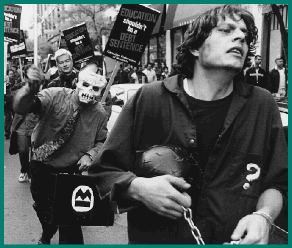 'University politics are vicious precisely because the stakes are so small'. These are the words of the notorious Henry Kissinger US secretary of state). Scarily enough this has often been quiet true of students Unions and the politics around them. Personality politics takes over and it can descend into a farce. This year can't and won't be the same. The stakes have now been raised to the highest they've been in decades. The OECD has now said that third level fees should be reintroduced and everyone seems to be treating it as a fait accompli.
Basically the future of education is up for grabs this year. There are frightening prospects at stake here: Privatisation, reintroduction of fees and basic notions of democracy are on table and the student movement could very easily lose. This is one year college politics are important. This year you have a damn right to be vicious if the S.U. isn't doing its job and organising.
Students' Unions like trade unions, were founded to defend and advance the interests of their members against the attacks of the state and college. The college structure is un-democratic and hierarchical, and in contrast our unions are democratic and the officers are accountable, constitutionally at least. The unions are based on the principles of direct democracy, where the mass of membership have final control over what decisions are made, and representatives have to carry out mandates and can be hauled up to account. In this role the union promotes self-management and empowerment among students. However, with a high student turnover, the only permanent force in the unions is elements of the college authorities them-selves.
Taken aside and fed bullshit about their own importance by the college, many union officers end up as apologists for actions taken by the college authorities, instead of standing up to them for their members. The union ends up filling the gaps left by the college and state, putting band-aids over symptoms instead of striking the root cause. For instance, instead of tackling the housing crisis by combating property speculation and fighting for an extension of rent allowance to students, unions play the role of agencies in advertising houses.
Where the unions should be fighting on issues, instead it ends up managing them on behalf of the college and state Often with a leadership who's main priority seems to be keeping things ticking over, rather than acting to empower the membership in fighting for a better life and a better education.
As anarchists we argue for mass based campaigns that involve general participation in making decisions as well as implementing them. This means organising from the grassroots up. Involving students in the decision making process through open non-hierarchical meetings, where anyone can get involved. Instead of expecting them to show up and passively take part in events they have no control over. A union's strength lies in the mass of numbers it contains, not in the limited abilities of individual officers.
One of the greatest tricks the right tries to pull at every union election is to convince us that politics should not come into student unions. What sort of bullshit is that? Everything is political and the issues facing students are loaded with political content and they need a political response. Unfortunately, the student unions are lacking a sense of political purpose. Overall the movement has no clear aims, it is more concerned with making 'bad things go away' than actually identifying what the core problems facing us are and fighting on them. When ever the state plans something dodgy around education, our leaders can be heard criticising it on the radio, and usually that's that. There is no one putting across a clear perspective on what we actually want to see happen in education. The student movement reacts to the state's agenda instead of attempting to set the agenda.
The state and college can easily close it's eyes and ears to the student movement and ignore the union's lobbying. But what they can't afford to do is ignore direct action based tactics, which disrupt the college structure and force them to give into demands. The recent successful UCD library occupations over opening hour cutbacks is an example of this. These sort of actions threaten the college more than anything because they are the ones that involve students alongside staff and give them a taste of their own power. And that is what the college and state are afraid of most of all.
For the past few years, the student movement has been struggling to retain many of the victories of the past such as free fees, if we continue to act defensively we can expect to get no where. Now more than ever we need to be on the offensive, putting forward a vision of education where the participants in education, workers, students and academics have a direct say in the decisions made. After all, regardless of how much we whinge about how we are being treated by the powers that be, in the final analysis, the problem comes down to one of control over within the decision making structures.
Currently our colleges are ran by faceless bureaucrats and un-representative decision making bodies which consistently act against our interests. Most governing authorities, while giving token representation to trade and student unions, are dominated by people appointed by the state. Even then they just act as rubber stampers for various practically anonymous committees running our colleges. Would UCD Governing Authority have made the decision to increase post grad fees by 10% if it was composed of people directly elected by students, workers and academics instead of cronies of business and Fianna Fail? I think not. Why was '1.6m spent on Hugh Brady, the UCD president's house, when the college can't even afford to fund the library for books?
And then, there's the state, and institutions like the OECD, in whose interests do you think they are being run? The OECD recently recommended the re-introduction of fees dressed up in the usual bullshit about social inclusion. But a peek at whose running the show, a former Australian minister of education Dawkins and his track record back home, shows that such changes only benefit the well off. Why has the Irish state being so reluctant to properly fund grants, student accommodation and to tackle the wider inequality in communities which is where educational inequality really begins?
If you're one of the thousands of people who see the reintroduction of fees as the end of your third level education there is no use moaning about it when it happens- get out there and stop it. Go to meetings or even better organise one yourself, go to the protest you organised. Get stuck in because if you don't your about to get royally shafted. Don't forget it was beaten by students just like you two years ago. Those in control of these decisions are making them in the interests of business and the rich, that's quite clear. We need to stop them.
An article from No Masters Issue One
(0) comments
Tuesday, September 20, 2005
Interview: Noam Chomsky Speaks Out On Education and Power
 Noam Chomsky is a professor of linguistics at the Massachusetts Institute of Technology. In the 1950’s he redefined the field of linguistics, but outside of his linguistic work, he has become famed as a political dissident for his work in exposing the reality of American foreign intervention across the globe and in his analysis of the power structures governing the media machine guaranteeing the proliferation of ideas benefiting the established social order and elites. The New York Times described him as ‘arguably the most important intellectual alive.’
Last year in UCD, he received an honorary fellowship from the Literary and Historical Society, when a packed out Theatre L gathered to watch him speak on US intervention in Iraq, the media, the Regan administration and its undermining of democracy in South America. Among his books are Necessary Illusions, Deterring Democracy, Rogue States, Understanding Power and Manufacturing Consent which has become a standard on sociology courses. We managed snatch an interview with him over email for the ever controversial 2004 UCD Freshers’ Guide about how he sees education.
What purpose do you think current education systems serve in Western society?
Multiple purposes. One is to provide students with the capacities to fit into the existing society at some level regarded as appropriate -- different for Yale students who join the Skull and Bones secret society and those who attend state colleges with the goal of becoming police officers and nurses, just to take two cases. Another is to enable students to enrich their lives by exploring human cultural achievements, and to participate in them. Another is to advance science and scholarship. Another is to socialize the costs and risks of economic development while privatizing the profits, by research and development under government contracts; these are core elements of modern economies, including the parts you and I are using right now: computers and the internet. And one reason why one cannot speak very seriously about "free enterprise economies," "entrepreneurial initiative," "consumer choice," and other familiar mantras, except in a rather limited sense.
Do you think third level education is limited by those with a vested interest in maintaining the current system?
In every society, domestic concentrations of power influence and seek to constrain the educational systems. Sometimes this is quite explicit, particularly when it seems that ordinary disciplinary measures are failing. The activism of the 1960s, for example, was very frightening to those in power. One very enlightening illustration of their thinking, which should be widely read, is the first report of the Trilateral Commission, called The Crisis of Democracy. These are not reactionaries; rather, liberal internationalists from the US, Europe, Japan. The Carter Administration was almost entirely drawn from their ranks. The "crisis" they perceived was that the industrial societies were becoming too democratic. Special interests were having too much influence: young people, women, minorities, farmers, workers, etc.; in short, the general population. These normally obedient and apathetic sectors were even entering the political arena to press their concerns, causing an "overload." They therefore counselled measures to bring about more "moderation in democracy," by restraining such unseemly behaviour.
To be sure, there was no recommendation that corporate power turn to apathy and obedience. Quite the contrary. That is not a "special interest"; their interests are "the national interest." At that time, the highly class conscious business world was rapidly escalating the bitter class war in which it is always relentlessly engaged, with a huge increase in the number of lobbyists in Washington, an explosion of ultra-right "think tanks" seeking to shift the narrow spectrum of mainstream discussion very far to the right, domestic and international policies (such as neoliberal measures) designed to reduce the threat of democracy, etc. One of the Trilateral recommendations had to do with the institutions responsible for "the indoctrination of the young," as they put it: schools, universities, churches, etc. They were allowing too much freedom and independence of thought, and that cannot be tolerated in a "democracy," because it might lead to consequences.
Measures have been taken since to overcome these deficiencies in the educational system. One is to increase tuition so that students incur serious debts, a very good disciplinary measure. And there are many others. In moments of perceived crisis, these ideas are actually articulated, but they are always operative to some degree or other.
As an academic you have proposed quite counter- hegemonic theories on the role of the U.S. government in world affairs. Have you ever faced censure within M.I.T. due to this?
Never. MIT has a very good record on issues of academic freedom, not perfect, but very good. That is a striking and instructive fact. Thus in the 1960s, MIT was one of the major academic centers of resistance to the Indochina wars, not just protest but direct resistance, and some faculty members were quite extensively and openly involved: I escaped a probably long prison sentence largely thanks to the Tet offensive, which turned the business community against the war and led to the cancellation of trials. At that time, MIT was almost entirely funded by the Pentagon. But it was very free internally. Those facts merit some thought. They reflect facts about our societies that are not always understood.
If so how have you dealt with this?
It hasn't arisen within the university. Of course it does elsewhere all the time. The best way to deal with it is to ignore it, as much as possible, and continue doing what one thinks should be done.
Students in Ireland and in the E.U. may soon be facing the privatisation of third level education. Many Irish students are opposed to such a move. What is your personal opinion of the Private education system?
The right to education is a fundamental human right, which should be enjoyed by everyone. Providing it is a community responsibility. Forcing people into private schools is highly improper, in my view.
Based on the current political climate, (where all western economies are endorsing neo-conservativism to vary degrees) what do you see as the future of Education?
That's for us to determine, not to speculate about.
Do you think students can have any say in its future?
Sure, as often in the past. College students are, in many ways, more free than at any other time of their lives. They are to some extent on their own, for the first time, and are not yet under the discipline of the job market. Particularly in their own institutions, they can have a substantial effect. Colleges today are far more civilized than they were 40 years ago, in large measure because of student activism. And the same is true of the larger society, in significant respects.
What is your ideal vision of education? Who should be the decision makers in universities in such a system? How do believe such a system can be achieved?
I'm not smart enough to contrive ideal visions. In any institutions, the decision-makers should be the participants, in coordination with the larger community of which they are a part. Within the university that means faculty, students, staff. Exactly how this should work out raises all kind of questions to which one cannot give answers in abstraction from specific circumstances and conditions. I do not know of any reason to doubt that more freedom and democracy can be achieved, without known limits.
Labels: Chomsky, Education, Interviews, Politics
(0) comments
Saturday, January 03, 2004
Interview: Chilean Student Activist On Educational Reform
What sort of issues do students face in Chile?
Well, the biggest issue is the problem of privatisation. Secondly you have the problem of repression as well, there is a lot of repression against the student movement that tries to organise and fight back against the privatisation measures. That of course is a situation that comes out of the time of the dictatorship, from the reform of 1980 when there was a big cutback in education to allow the private sector to start investing more.
So you say 1980 was a period of intensive cutbacks to force privatisation, that appears quite similar to what the Irish state are doing now, what sort of reforms were brought in back in Chile?
In the University of Chile where I was studying, just 30% of the income is public sector, 70% comes from the private including fees, so that gives you an idea of how important the private sector is in education in Chile and how much of a business is as well. Of course all that happened through forced measures under the dictatorship when the mass movement had many other tasks to face as well. So I think in Ireland you are in a better position to fight it off because you don’t have such a repressive context in which you have to face military rule.
You say repression as well as privatisation is an issue facing the student movement in Chile, what exactly do you mean?
Well, you’re talking about a very subtle repression in some ways. Most of the academics were appointed under military rule, they got to university that way and they reproduce the same kind of people in the academy. Academics tend to be very right wing and the student movement tends to be very left wing. The most obvious form of repression is police repression. Every student march will finish with water cannon, with a number of students in prison with batterings, students in hospital; it’s really bad on that point as well. Every student march is the same, loads of tear gas, loads of riot sticks, it’s always the same.
So how does the student movement organise?
Well it’s basically organised through student federations and student unions, some federations are more militant than others, some have more rank and file organisations than others, you have federations that are in the hands of the right, some are strongholds of the left.
What sort of tactics have the Chilean students’ movement found to be most effective?
It varies from federation to federation, from students’ union to students’ union. Of course the most effective tactic is direct action, and of course I am an advocate of that, but there is always a tension between groups, we are always demanding rank and file action, real measures of pressure with struggle, and then there are those that are fond of lobbying. The right-wingers don’t really privilege any tactics, they just want the student union to organise football matches and stuff like that.
How does the student movement link in with other sectors?
Well, student movements in Chile have never been isolated, they have always played a very active role and been active participants in politics in general, both in reactionary politics and revolutionary politics, but the student movement has always been leaning to the left as a general trend and there’s always been historical links with the working class that go back to the beginning of the twentieth century. Actually the student movement was built on the revolutionary unions that at that time were all illegal and they were born as means of direct struggle and points where the working class met with students in the struggle for a better society, so that link always existed.
At the moment Ireland is witnessing a trend of neo-liberal reform, with a push being made for privatisation in education, transport and other sectors. Chile under military rule was a playground where these ideological models were played out first, leading some economists to claim there was an ‘economic miracle’, what do you think of neo-liberal reform in the public sector?
Well, Chile’s the best example that it’s not working. If you look at the distribution of income, if you look at the quality of public services, it’s appalling. There has been the rise of an elite, where only the privileged sectors of society have access to third level education. But the working class find it more and more difficult as each day passes. Not only access to education has been affected, it affects the whole education system. The wages of teachers get affected, so teachers have to work outside education as well, so university becomes more a burden for them than a real job, where they can dedicate real time. There are many problems where labs are in decline, research is in decline, there is a concentration of research. It affects education at all levels, we had very good top research, and it’s all gone in twenty years of neo-liberal reform.
If you are of the privileged, of course it’s a brilliant economic miracle. Of course if I’m getting richer, I’d tell all the world. But if you are working class, and are obliged to work twelve hours a day legally, if you have no rights at all and have been systematically abused under the administration, if you know your offspring have no hope of going to third level and are always queuing for crap public health, you will find it pretty tough to talk about an economic miracle. It all depends on what side are you on, it’s all class struggle.
What advice would you offer the student movement in Ireland?
Oppose fees at all costs, because it will rot the whole education system. If education goes down, society in general goes down, research, even life expectancy. But the most important thing is to understand that it’s an ideological battle, its not about whether you can afford fees, most Irish students don’t give a shit, most could afford the fees the state are offering, but the point is you can’t accept education as a commodity and not a right. It’s the most important thing, it’s a matter of principle not a matter of whether I can afford it. It’s a really different struggle, which can only be won if you really build links with the wider social movement, with the unions, with workers and their struggles.
Labels: Chile, Education, Interviews, Politics, South America
(0) comments
Saturday, December 20, 2003
The Death Of Free Education -Sneaking Fees In Through the Back Door
As part of his first significant moves as the new Education Minister, Noel Dempsey has also increased the standard maintenance grant by a pathetic 5%, representing an increase to 2,510 euro a year. A rise which will barely cover the projected rate of inflation for 2002, and go no where near tackling the tackling the huge discrepancy between the real cost of attending college, judged by the Irish Times today to be in excess of '6000 Euro for Arts, law and business courses, 8000 euro for science courses and 9000 for engineering courses' (1) and the amount received by students on the grant. It is perhaps the most cynical aspect of Dempsey’s move that he has attempted to disguise it in a facade of social inclusion. Increasing and extending the 'top up grant' for more disadvantaged students, on the same day that he has almost doubled the student registration fee. The reintroduction of tuition fees in Britain upon the election of New Labour was also dressed up in the rhetoric of wealth distribution and social inclusion.
In a press release responding to the Ministers Announcement, President of the spineless bureaucracy and talking shop that is the Union Of Students of Ireland, Colm Jordon described how 'It is little surprise that the Department chose to bury this news on a low key Friday morning in July when students are on a seasonal break rather than at a time when they can vent their fury at this disingenuous move.' (2) In a way it is perhaps fortunate for many of those holding office in Student Unions across the country, that the government has decided to make its move at such an opportune moment, when students bodies are broken up. President of UCD Students Union Aonghas Hourihane, best known for using the national media to air his support for the Garda violence and state repression which plagued the May 6th Reclaim the Streets Party on Dame Street, expressed disappointment at the rise in registration fees, but welcomed the rise in the grant. It was the UCD SU, which put forward the motion at USI National Congress two years ago which saw the cancellation of the effective campaign of demonstrations, occupations and days of action, which saw the government concede an additional top up grant and a five percent, increase in 2001. UCD SU is effectively in boycott of USI, after a co-ordinated attempt to sabotage the national union by abolishing many of the key full time positions within it, by Fianna fail controlled unions was set back by a number of months. USI have said they will make a 'comprehensive response to these announcements’, which will probably result in nothing more than another press release.
In the framework of GATS, free fees for undergraduates and the grant are defined as discriminatory payments and are being slowly phased out as governments across the world implement GATS. Jordon is correct to point out in his press release that Dempsey’s move represents an attempt to 'introduce fees by the back door'. Students in Spain have already fallen victim to the extensive intrusion of the private sector into education, with the right wing government’s introduction of the LOU and they have responded with a series of waves of protest. European student groups, networking over the Internet and outside the official structures of their unions if needs be, have been engaged in a 'Hot Summer Of Protest' (5) against attacks on education. In one example of the anger among continental students, on June 18 following a wave of occupations and decentralised protests 8,000 students stormed the regional parliament of the German state of North-Rhein-Westphalia. Check out http://education.portal.dk3.com/ and http://www.education-is-not-for-sale.org for more comprehensive details of what has been happening across Europe. Student blocs have been organised at the past two EU Summits, as opposition rises to the EU Commissions implementation of the Bologna Declaration of 1998, which seeks to pave the way to a uniform system of higher education, all in the vein of privatisation.
Education in Ireland too is facing into a period of major restructuring and change. Despite claims made by successive governments about improving access to third level education, not a lot as changed since the abolition of college fees in 1995. The refusal to significantly extend the ridiculously low income threshold which determines if a student receives the grant means that only 37 per cent of university students and 47 per cent of students (to use Minister Dempsey’s figures) in ITs receive financial support from the government. The composition of those attending third level education hasn't seen any significant change despite the creation of free education' at third level. In fact the past decade has only seen a 0.02% rise in the number of disadvantaged students reaching third level. It is a harsh reality, that those with most to gain from campaigning and fighting for a decent accessible education system are not those already in third level education but the hundreds of thousands of secondary students and young workers who will never reach third level because of the financial impediments maintained by successive governments. The attitude that dominates many of those holding office in student unions is that concern should not stretch beyond those already in college. Any attempt to broaden the horizon of student unions is met with declarations that they are strictly apolitical bodies, with a leadership more concerned with maintaining services on campus, than tackling the educational disadvantage that ensures those same campuses remain the sole reserve of the lucky few. Those in the positions of most influence in Unions are only to willing to admit their complete ignorance of issues like GATS and privatisation and when forced to act will dismiss and whitewash concern as the paranoia of the Looney left.
The Skilbeck report issued by the Higher Educational Authority a number of months ago gives ominous signals for the direction of Irish Education, recommending among many things the abolition of the grant, re-introduction of tuition fees, increased links with industry and increased use of money from the private sector to fund education. A similar move by the government in 72-73 when the attendance fees were raised from £87 to £105 led to a weeklong occupation of Earlsfort Terrace. A rise in capitation fees in the early 90s also led to a 100 strong-attempted occupation of the UCD Administration building. The Skilbeck report didn't cause many in leading student union positions to bat an eyelid. The main organised criticism in UCD came from the SIPTU Education Branch there and not from the student union. A poll on http://www.usi.ie perhaps confirms many things, despite the development of the anti-capitalist movement here; student activism is not as strong as it once was. The majority of students today are engaged in a very different kind of struggle, and that is the struggle for economic survival.
(1)http://www.ireland.com/newspaper/front/2002/0719/1057692384HM1EDUCATION.html
(2) http://www.usi.ie/news/fees18july.htm
(3) http://www.geocities.com/swapersie/lettertopres
(4) http://int-protest-action.tripod.com/id55.htm
See http://www.education-is-not-for-sale.org for organsised student resistance across borderrs against attacks on education
See http://int-protest-action.tripod.com/id11.htm for an archive of articles relating to education and privatisation
Labels: Education, Indymedia, Politics
(0) comments
Wednesday, November 05, 2003
UCD Students Protest At Fianna Fail AGM
As the senator gave her address to the assembled throng of KCB hacks, CFE activists burst into the lecture theatre and held up placards. Slogans such as 'Education is Not For Sale! Lecturers Are Not Tools and Students Are Not Products', 'Education Is A Right Not A Privilege' and 'Education For The Masses Not the Upper Classes' were held up in a silent protest against the recent and continuing attacks on the Irish Education System. After listening to her bloody rambling speech, I regretted not making a placard with the slogan 'Not Only Do You Fuck Us Over-But You Bore Us To Death.'
Interestingly enough from what I could gather one of the main discussion points of their AGM was the obvious adverse reaction of students towards their governments attacks on education.
The protest was an ad hoc affair and organised at the last minute, the pressures of exams and the lethargy of a year of hyper activism within and outside UCD obviously having an impact. Last night was also a day for the discerning protester, what with the choice of Haider and Brennans possibile appearance, which was cancelled. It must say something about the evolution of UCD politics this year when UCD activists could make a choice of protest without any major worry about a UCD based one having insufficent numbers.
In response to the criticisms raised on Indymedia about holding this protest, when bigger fish like Hiader were in town that needed frying. Well, the simple reality was that because of UCD's upcoming exams, most of those at the KBC protest were not actually going to be going into the Haider Protest, so no harm was done to that mobilisation.
While the protest was small, and no way comparable to the level of resistance which has sprung up at various points in UCD this year, it is significant to note that there has been a CFE protest anytime public representatives from the governing parties have been on campus, ranging from 300 strong blockades to last nights smaller affair.Originally published at Indymedia.ie
Labels: Education, Politics, UCD
(0) comments
Saturday, April 12, 2003
Soul Searching in the Library: Welcome to the Occupation
The nights reached that stage where all that is left is what has to be cleaned up in the morning before we shuffle off dazed towards lectures and in most cases bed.
Usually confined to surfing around the online library catalogue, someone with more computer related knowledge than me stumbled upon a function key which by passes the need for address bars, and allows the more googgled eyes of us to escape onto the superhighway and spend the last few hours scavenging across the internet for entertainment and distraction.
Apparently, this is the first overnight occupation of a UCD building since 1984, when students occupied part of the library building because of administrations refusal to finish construction on areas of the building. Whether or not this is true could probably be verified by someone on the newswire. That is the nature of the student movement, the constant cycle and turn over of students mitigates against a collective memory which remembers these things. The hyper activism which characterises student activism means there is little emphasis on sitting back and contextualising or analysing the events the movement sees unfurling.
Tonight saw over 300 people engage in a two hour reclamation of library time that was cut back upon by the college authorities as a a response to cutbacks initiated by the government as part of its ideological attack on the value of public services. Its hard to gauge the exact figures of those who chose to stay overnight and occupy the building until it opened the following morning. Essentially after the study in people naturally broke away into smaller groups of friends to wile away the time. Meanwhile, a desperate few prolonged later into the night to finish essays and cram for the duration for exams in the morning and later in the week. But there doesn't seem to be a significant decrease in the level of space taken over by people, perhaps as many 75% of people stayed.
Previous to this years round of cutbacks; the library was open on friday evenings, all day saturday and on sundry. The cutbacks see these periods taken away. Originally the library sit in was conceived at discussions on cutbacks in the college and the strategies need to fight them at an open plenary discussion on education at the SU Class Rep Training Event earlier in the year.
Before the first sit in, some of us waiting anxiously to begin outside in the library tunnel joked that this was UCD's March 1st, that is an openly planned and collective direct action. The class rep who proposed the idea walked past, jokingly branded an anarchist while we waited for her proposal to take shape she responded with confusion to remind us she voted Fianna Fail.
Perhaps, that is reflective of the nature of direct action that it is a form of political struggle which cuts across doctrine as when it applied to those often most basic issues directly affecting people, they see it as a logical strategy because fundamentally it is one that can win.
The student movement is characterised by protest occupations, whose goal rather than occupying space and using it as a political bargaining tool or as part of an attempt to spread and build a wider movement is to only occupy a few inches in the mornings tabloids, preferably with a photo loaded with radical posturing; just for the cameras of course.
This is different. While essentially tonight is a protest occupation; making it evident to the authorities how serious we see this situation a nd our willingness to engage in confrontations over it. The whole process has been one whereby extra hours in which to study have been reclaimed by students in a simple refusal to leave when the college decides its time to go.
Rather than being made up of the usual, recognisable enthuasists and idealists; these actions have been composed of a broader swathe of the UCD student body. These are the Science/engineering/vet/med type students who need extra library hours, those students who never before have taken a role in active dissent because usually the hours allocated for meetings and events by a movement dominated by arts students are hours in which they lock themselves in labs and compulsory lectures they have no chance of bunking for half the year.
The library staff have supported the occupation all the way, sitting back and watching it happen, leaving us to our own devices, letting us outside to the smoking area below the library and sneaking our friends in through the back door after Radiohead at the point. There is sometimes a tendency to simply seeing two aspects to the college community; academics and students. there is a third forgotten strata; cleaners, librarians, technicians and so on those that keep the college ticking over functionally; those for whom the college represents a workplace rather than a place of research or study. It is probably not surprising to see that it is from this strata that most support for the sit ins emerges. While some have vocally supported the sit ins in their lectures after lecture addresses from union activists; the academics are strongly fucking noticeable by their absence in these events. Good to see the academic Marxists, radical social theorists and all those others leave it at the lecture and office door. If academia ever represented a containment and isolation of dissent within texts then here you go.
Today saw a 3/4 full bus leave UCD for a USI National Demo in town. In one way this can be interpreted as a negative sign. I'd propose a different reading of events. Tonight saw a a mass of people engage in an effective form of action which has galvanised support across the college and left the college authorities scratching their heads in embarrassment. Some will say that there is a higher turn out because people are here for the experience, the buzz and to piss about in the library with their mates. So what if many are? They have still cut across the colleges authority in refusing to obey its dictates on opening and closing hours; and are willing to face disciplinary measures as a result of this. That this confidence has arisen because of the collective nature of the occupation, the collective confidence of those taking part should be of no surprise.
Maybe it doesn't suggest a disappointing downturn in student consciousness that so few turned out for USI today. Maybe students are just discerning about what forms of protest are most effective when two clear options are presented to them. The two options presented to UCD students today were simple. To march around town in what unfortunately has become an annual sham, where USI Leaders cheer lead from a platform and feign radical rhetoric as we whoop from behind the police pen, before they ask us all to piss off home our job is done now that the Star have a wonderful back ground for the mornings photographs. Where student leaders handcuff themselves to the railings of the Dáil and helpfully uncuff themselves after a few moments of choice poses for photographs.
That students are treated like consumers in vain attempts to sell them a product packaged to resemble something like dissent, with no role in its organisation, merely to consume it at the behest of some bloke noone recognises (apparently he's USI, well thats what the t-shirt says, innit? Fuck it i didnt vote for him...) is one aspect that probably has undermined participation in these events.
The other option was to partake in a protest where everybody played a part, in which everyone had the option of playing a role in its organisation and rather than being the witnesses to its futility, could see its fruits unfurl as they engaged in it. That is direct action and I for one are glad to see the choice they made. Meetings that have taken place with the president and incoming president has seen them vocally agree with us. Now the issue is to force their hands into finding the funding needed and rather than tailing the governments ideological agenda (as they did with fees) openly oppose it and side with the fight for an open public and free education system for all. As a temporary measure we should continue and normalise these sit-ins till midnight as a means of directly creating more studying hours while escalating protests elsewhere.
Hopefully we can see more of this shit around Irish campuses. Its called direct action, and it works.
Originally published at Indymedia.ie
Labels: Education, Politics, UCD
(0) comments
Thursday, October 03, 2002
UCD Students Protest For A Grant That Matters
In a demonstration outside the Department of Education and Science last Thursday students from UCD called for an open publicly funded accessible education system for all. Around 60 students took part in the demonstration which was the result of a motion put forward by grass root councillors in the student union in response to the failure of the Union of Students Ireland to take any form of action over the grant issue this year apart from asking students to vote in the upcoming May general election, in an effort to apply pressure to candidates to take action on the grant.
Students chanted '1-2-3-4! The grants a joke and we want more! 5-6-7-8! Extend the grant to educate!’ ' Outside the department before listening to speakers from UCD union as well as Colm Jordon, an officer in USI.
When Aonghas Hourihane, UCD Union president and member of Fianna Fail emerged from the crowd to speak he was greeted with jeers, one student shouted 'Fianna fail are the problem not the fucking solution!' In his speech he commended
The recent introduction of a supplementary top-up grant for students from backgrounds where both parents are receiving social welfare but called on his party to include a more decisive increase and extension in their upcoming election manifesto. The second speaker Paul Dillon one of the coordinators of the demonstration expressed with considerable anger his personal anger at the grant level, as well as how the assembled students at the demo were the lucky ones who had got to college, he warned the government that to ignore the interests of students in an election year would be extremely foolish. Colm Jordon, an officer with USI pleaded with students to register their votes and sign the voter pledge forms which are being sent to candidates across the country in an effort to force action on the grant. USI's Pat the Politician Campaign has been greeted with derision by many students in UCD who seek a return to last years days of regional and centralised protests which resulted in the introduction of an increase of 5% and an extra top up grant.
The students continued to demonstrate, ignoring calls from the union president to return to the busses and go back to college, the demo preceded across the Liffey towards the Dail. Upon reaching Trinity a sizable number of students attempted to gain access through the front arch, in an effort to pull Trinity students in to the contingent but were stopped by security that closed it off. Marching up Grafton Street the demonstrators chanted 'Grants, grants, grants for all! Not a corporate free for all! Fight! Fight! Fianna Fail’ At this point a handful of secondary students joined the demonstration which ended outside the Dail.
Members of Socialist Youth contacted socialist Party activist and TD Joe Higgins; he agreed to speak to the assembled students. At this point the Union president seized the union banner and abandoned the demo, calling it off and led students back to college.
20% of students in UCD receive some form of subsidy from the state to fund their education, less than 10% receive the full grant of e65 a week. Placards on the demonstration reflected the pathetic level of the grant through the slogan 'when your rent is e100-e65 doesn’t matter.' There is a real and persistent threat to even this pathetic funding of education as a result of the General Agreement in Trades and Services, which seeks to remove all barriers to trade in services. One such barrier is the third level maintenance grant, and government subsidisation of college fees. Recent government reports have called for an abolition of the grant and the reintroduction of tuition fees.
Next week Michael Woods will take part in discussions with other European Ministers for education in Spain. The discussions will focus on the intensification of the Bologna process, which seeks to introduce a uniform system of education, in line with GATS across Europe. Massive attacks on public education across Europe resulted in mass regional actions before Christmas. On March 15, further student, pupil and teacher actions will take place across Europe to coincide with demonstrations taking place in Salamanca, the venue for the EU talks on education. In Ireland, USI have remained silent over the GATS threat, the extent of their discussion of it this year will be the discussion of a joke motion at upcoming congress put forward by members of the Fianna Fail Cumann in UCD. The motion says 'we should globalise now'.Originally published on Indymedia.ie
Labels: Education, Indymedia, UCD
(0) comments
About Soundtracksforthem specialises in iconoclastic takes on culture, politics, and more shite from the underbelly of your keyboard. A still-born group blog with a recent surge of different contributers but mainly maintained by James R. Big up all the contributers and posse regardless of churn out rate: Kyle Browne, Reeuq, Cogsy, Chief, X-ie phader/Krossie, Howard Devoto, Dara, Ronan and Mark Furlong. Send your wishes and aspirations to antropheatgmail.com
Label Cluster
In no certain order...
Politics,
Guest Bloggers
Interviews,
Music,
Internet,
Guest Bloggers,
Travel,
Blogging,
TV,
Society,
Film,
Gig Reviews,
Art,
Media.
The Neverending Blogroll
A Womb Of Her Own
Arse End Of Ireland
BlissBlog
BBC One Music Blog
Blackdown Sound Boy
Buckfast For Breakfast
Customer Servitude
Counago & Spaves
C8
Candy PDF Mag
Guttabreakz
House is a Feeling
Homoludo
Infactah
Indymedia
Indie Hour Blog
Jim Carroll
kABooGIE MusIC
Kid Kameleon
Kick Magazine Toronto
Libcom
Matt Vinyl
Modern Cadence
Mongrel
Nialler9
One For The Road
Old Rotten Hat
Pitchfork
Salvo
Spannered
Sigla
Test
Thumped
Newish Journalism
TV Is Crying
Uncarved
Una Rocks
Urban75
Weareie
WSM
Wooster
Village Magazine
Radical Urban Theory
Archives
February 2002
October 2002
April 2003
September 2003
November 2003
December 2003
January 2004
February 2004
March 2004
June 2004
September 2004
January 2005
February 2005
March 2005
April 2005
June 2005
July 2005
August 2005
September 2005
October 2005
November 2005
December 2005
January 2006
February 2006
March 2006
April 2006
May 2006
June 2006
July 2006
August 2006
September 2006
October 2006
November 2006
December 2006
January 2007
February 2007
March 2007
April 2007
May 2007
June 2007
July 2007
August 2007
September 2007
October 2007
November 2007
December 2007
January 2008
February 2008
March 2008
Gig Review: The Fall Tripod
Gig Review: Gogol Bordello
Broken Pencil Gets It's Irish On
Fecking Civil Servents
Fake Pharma Ads
Vidiot: Data Entry
Life and Debt
Last Night Cosmo Baker Saved My Life / Hip Hop His...
Eye Candy: Dufferin Hoarding Gallery
Review: Heads for the heart of the Sun – The Welco...