
Monday, January 08, 2007
Two Months In Print: From the Book Exchanges Or Not?
 The stalls may be bustling with Spanish language editions of Dan Brown sitting alongside The Art of War and Das Kapital, but the best you'll manage is to scan through a daily tabloid and come away with a faint understanding . Well thats the experience of an Spanish speaker in South America. This gives a weighted importance to book exchanges in hostels. Far from being bursting, divergent little caves of taste and interest, invariably they included two shelves of semi-erotic romance novels, spy-fiction in abundance and multiple out of date travel guides. Here's some books I got around to reading on my travels. You can judge what came from the exchanges and what came from ruthlessly rooting around markets yourself. In the spirit of 60 Seconds On Film here's some reviews. Rueeq had a similar idea and reviewed some of what she read, doubling up on some of the ones below and others.
Primitive People, Francine Prose This is exactly the sort of book that old adage on judging by the cover warns you against. A forceful, blurb bends you towards this supposedly, acerbic anthropological satire of American, middle class suburbia. This is Wisteria Lane as seen through the eyes of Simone, a Hatian migrant economically conscripted as "care giver" to the permanently crisis prone divorced Rosemary.
The authors finger is on the trigger when it comes to characterizing the shallowness of the upper middle classes, simultaneously wrapped in dilemmas about their own status, then flaunting it or trying to off-set it through New Age philosophy or exploring the artist within. Cringe inducing incidents provide the backbone of the humor, and then like one Desperate Housewives voice over too many it all becomes a little too tedious to bother finishing. Death in the Andes, Mario Vargas Llosa Llosa is a writer to make your spine tingle. In this delicate combination of love story and detective noir he crafts a modern horror relying in equal dose on the natural spookiness of the Peruvian mountains and the violence of Sendero Luminoso. The Senderistas become confused and intertwined with demons of the hills in this clash of rural/urban and furoe into the persistence of pagan belief among Andean peasants. The plot unfolds around a coastal city Civil Guard Corporal Lituma, who lands a rural out-post investigating the mysterious death of several laborers on a road-works.
It's a series of narratives within narratives, on one hand Lituma's lovelorn side kick interrupts the textual flow with flashbacks to his own romance with a former prostitute. On the other hand Lituma, tortures himself with imaginings of the bawdy drunken debauchery foisted on road laborers by Dona Adriana and her husband the mystic Dionisio who run a shanty roadside canteen. The ancient and modern collapse into each other, leading to a violent and iconically charged ending that immediately brings the Wickerman to mind.
From Gangland to Promised Land, John Pridmore Remember those secondary school afternoons when some lunatic with a history of drug addiction, mental breakdowns and violence held your class rapt with tales of his visitations from God? Yes well John Pridmore is one of these retreat running men. In Carlow one particular wild haired, former seventies rocker, a skillful story teller who noodled Zeplein on acoustic and warninged of their dalliance with satanic rites and the consequences on young minds. Pridmore never had such occult rock ambitions, instead he was a simple minded East-end bouncer with a short fuse. Pridmore successfully cultivates a soap opera hard-man on the downward spiral image, concoctions of drugs, women and lad culture take their toll and he first obsesses over some slight on his pub pride and then batters some kid near to death.
Mid way through his court case he of course turns to God, replacing a set of voices in his head with just the one. Amble on through a series of adventures in the poverty industry, where Holy John used his tough boy exterior to break down walls between youth and social workers and its all pretty much wrapped up until celebrity status strikes through the Youth 2000 campaign. There are some truly disturbing moments described as he sails through school retreats. One such class weighed heavy due to the presence of visibly upset and distant girl. In private Pridmore advanced towards her and told her the reason for her state of mind,as God had put it to him - serial childhood sexual abuse. If you want a picture of the mentallers still being dragged into our schools to shore up the moral fiber of our teenagers in religion classes, here's your start. You couldn't even begin to make this bollox up.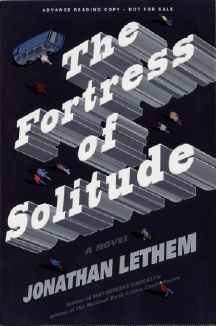 Fortress of Solitude, Jonathon Lethem One of the more brilliant novels to fall into my hands recently, but this loses its glittering attraction towards the end by eschewing explorations of the 1970's Brooklyn tagging and hip-hop culture for the personal trauma of growing up white in a black neighborhood. Though disappointed by the ultimate direction of this novel, it'd be foolish not to recognize how Lethem has made the area of racial tensions and its contribution to pop culture his particular area for mining anecdotal recalls from the very recent modern.
He builds up a plot around the shared mutual love of DC Comics, hip hop and robbing spray paint between two boys, one white, one black. That these two kids would take such dramatically different paths in life is an testament to the strength of racial separation in the states today, despite the mainstream acceptance of predominantly black cultures. Brooklyn breathes all over this book, you can be of no doubt that Lethem was inhaling its air as he produced the detailed accounts of building gentrifaction beginning with the '60's counter culture and then how crack first began to take hold in the projects.
History of Argentina in the 20th Century, Luis Alberto Romero Going by the Evita Museum and others in Buenos Aires, after the dictatorship came to power - it without reason dug up the first lady of the Peronista movement's corpse. The gaps between what most national history museums tell you and the reality of a country's politics is the reason you rush out and buy a book like this to fill in the blanks yourself. Romero has produced a book that does extraordinarily well on the undergraduate circle, its constant status as an instant reprint has led to more recent updates to cover the dramatic neo-liberal restructuring under Carlos Menem and the more recent uprisings from 2001 on.
Basically its a dry, academic history of Argentinian presidencies and their economic polices, the complexity of social movements are really only explored when they pierce out of and briefly push aside state hegemony as in the late 1960's and again in the late '80's and 2001. Though for an account of the social movements readers are best pushed off to reading the contemporary accounts the author himself will likely end up relying on for future updates. Romero successfully manages to give the new comer a grounding in the emergence of Argentina as a distinctly European South American city, his coverage of the Juan and Evita Peron movement, which in itself stands as a good basis for moving on to other periods while the corruption within the ruling elites is pleasantly left wide open for consumption.
 Wild Swans, Jung Chang This piece of history from below has probably sat on most book shelves since the mid-1990's, when it first had accolade after accolade thrown on it for its emotional detailing of the lives of three daughters of China. Its brick shaped size has put many off, but don't be afraid. What Chang has managed to do is create a highly engrossing account of three periods in Chinese history, from the period of war lords and Japanese occupation, right through to the civil war between the nationalist Kuomintang and the communists and then the most dramatic period of all under the stewardship of Mao and the cultural revolution.
At its best Wild Swans details the effect different forms of political hegemony had on the internal life world of the Chang family. The most astute renderings are the descriptions of the lives of women during the three periods, from the concubine existence of her grandmother and her struggle against it to her own mothers development as a communist as a slap in the face to the reactionary feudal system and its prescriptions on women. Wild Swans is a fantastic entry point to Chinese history, but the author's bleeding heart eventually becomes tiresome as you realize the gap between her parents sufferings and her own privileges.
 My Century, Gunter Grass There's a name that rings familiar, you associate it with terms like "intellectual tour de-force" or the obscurities of German left-wing writers. A lot is riding on it when you come across one of his books for the first time. My Century is an unusual novel, it rolls through what Eric Hobsbawn called "the century of extremes" in a series of personal tales told by 100 different voices for 100 different years. The years of the Great War are recalled by the hunched over authors of several war classics from a perch of four decades later, while the twenties and thirties are marked by the social crisis of German society between the struggling forces of Communism and the fascist response to working class organization.
Overall as this landslide of voices tumble down around you Grass presents a multi-faceted, overview of the complex questions that feed into the construction of contemporary German national identity which dominates the novel from the 1960's on and emerges strongly again in the era of re-unifaction. To be honest, that Grass received the 1999 Noble Prize for literature for this novel says more about the pre-millennial love for count downs than his writing talent.
Labels: Irvine Welsh, Literature, South America, Travel
(0) comments
Friday, August 18, 2006
Theatre Review: 'Stuck Here Like That Little Bitch In Oz'.
 The poster of a Munchkin clutching an over sized bottle of whiskey while peering up Dorothy's skirt summarizes the irreverent attitude of Babylon Heights. If the land of Oz lies over the rainbow, the spotlight here is on its far from pretty underbelly of lurid sexual violence, personal betrayal and drug dependency. Describing the Wizard of Oz as an 'indispensable part of our cultural heritage in the west,' Welsh's production with the Attic Studio, exposes the nadir where personal ambition is exploited by major studios, as humiliation and self abasement is forced on four Munchkin extras.
Welsh has spent much of his literary energy piercing the bubbles of comfortable modern fables. Just as Renton's 'choose life speech' in Trainspotting ruptured the materialist values of Thatcher's Britain, so too does this latest stage project with Dean Cavanagh roll a hand grenade under the door of popular American culture. Judy Garland's allusion to tales of drunken sex parties and drug abuse at the Culver Hotel, where the nearly two hundred Munchkin actors were segregated from the main cast, created one of Hollywood's most persistent urban myths.
These rumours of debauchery were given a typically frantic Chevy Chase treatment in a 1981 movie called 'Under the Rainbow.' Here they are exhumed afresh by a collaborating duo obsessed with the darker rumor that a Munchkin corpse can be seen hanging from a plastic tree in one scene. Taking myth as reality, the play constructs a manic hallucinatory reality at the heart of an enduringly innocent Hollywood fantasy.
In the past Welsh was fully capable of expressing the cultural zeitgeist of the acid house generation but recent coverage of this latest effort remain obsessed with these lurid tales of drug abuse and successfully manage to side line deeper concerns weaved into his work, such as the fracturing of traditional class identity in a novel like Glue.
Using regular sized actors against an enlarged scenario, Welsh strove to avoid pandering to 'a sniggering herd mentality' by provoking the sensationalist media surrounding this controversial topic. While it the play raised the goat of some disability organizations, its worth noting his previous exploration of disability. In one of the chemical romances in Ecstasy, a maladjusted Thalidomide victim manipulates a lover into extracting revenge on a company director responsible for the callous promotion of the devastating drug. Here the portrayal of the experiences of four actors of diverse backgrounds thrown together after being hired by a vaudeville retainer, is far from an elucidation of victim-hood for simple comedy as some critics have lampooned.
The 'palm trees, flora and fauna' that attracts one of the actors to Hollywood, are overshadowed by a set of towering bunk beds that quickly induce a paranoiac cabin fever among the characters. Routinely patronized for their small stature by a booming off stage voice representing the abusive and abrasive studio, underpaid and fed false promises of custom made homes after the shoot, these four characters have no possibility of clicking their heels and going home and as one exclaims they are 'stuck here like that little bitch in Oz' bent to the will of more powerful entities beyond their control.
The first half of the play is full of predictable gags that veer towards belittling the subjects at hand but ultimately these sit alongside some hilarious caustic commentary on the shooting of Oz. The comedic highlight is a self referential monologue on the use of the word 'cunt' as a precision piece of language to be carefully rationed, yet one punctuating so much of Welsh's work. The actors performances throughout are frantically goofball, at times a little overbearing and nearly collapsing into pantomine. Despite some a lack of dramaturgical depth, the play remains a brave but somewhat disjointed black comedy nightmare of the actual gap between Hollywood glamor and reality.
Finally joining the ranks of bloggers published in real time, this Soundtracksforthem review first appeared in edited form in the latest edition of the Village Magazine. Babylon Heights will be running at the Mill Theatre in Dundrum untill August 17th. Tickets are 18 squids and can be booked here.
An associated press review all over the net: Jill Lawless 'Munchkins run amok'
Other thoughts: I've been meaning to write something on Irvine Welsh for some time now, I'd even concieved the idea of writing my thesis for Equality Studies using him as a platform to explore the changing nature of class identity in post-modern society. Much of the coverage around his latest works have stunned me with their lack of any semblence of intellectual rigour. On one hand the British Tory press have attempted to re-cuperate him as a Cameroon supporter despite his own admission in one of the Sunday culture supplements, maybe the Sunday Business Post (you know how they all blur together..) where he stated he 'wouldn't vote for Cameroon in a month of fucking Mondays.' What I find interesting about Welsh is that behind his raver hedonism and acid casualty cynicism, a lot of his work chimes in with a broader left wing conciousness and the creation of popular narratives of class. For example the TV play 'Dockers' along with Jimmy McGovern, played an integral role in popularising the Liverpool Dockers dispute.
Something I've noticed among a lot of the angsty lefty young men I went to college with was a shared early teen propensity to both Irvine Welsh and The Manic Street Preachers. Lines like ' the difference between me and those fucking wimpy arsehole socialists. I don't want the Tories out, I want them fucking dead. Just because I've got a bus pass doesn't mean I'm part of the system. An anarchist with a bus pass is still a fucking anarchist' from Smart Cunt have always stuck with me as an articulation of a non-dogmatic socialism rooted in the social realities of what he calls elsewhere the 'long dark nights of late capitalism.'
This is a socialism increasingly needing an expression on the level Welsh could aspire to. The rant on the how getting up early to sell a couple of papers in a shopping centre is not being the best way to chill out after raving' drips with the bitterness of one faced with the destruction of proud working class histories at the hands of Thatcherism and the futile games of the Trotskyist left. There are more extracts from him posted at a discussion at Meanwhileatthebar. I'm interested in what Sinead has to say about both the play and his new book.
Labels: Irvine Welsh, Theatre
(1) comments
About Soundtracksforthem specialises in iconoclastic takes on culture, politics, and more shite from the underbelly of your keyboard. A still-born group blog with a recent surge of different contributers but mainly maintained by James R. Big up all the contributers and posse regardless of churn out rate: Kyle Browne, Reeuq, Cogsy, Chief, X-ie phader/Krossie, Howard Devoto, Dara, Ronan and Mark Furlong. Send your wishes and aspirations to antropheatgmail.com
Label Cluster
In no certain order...
Politics,
Guest Bloggers
Interviews,
Music,
Internet,
Guest Bloggers,
Travel,
Blogging,
TV,
Society,
Film,
Gig Reviews,
Art,
Media.
The Neverending Blogroll
A Womb Of Her Own
Arse End Of Ireland
BlissBlog
BBC One Music Blog
Blackdown Sound Boy
Buckfast For Breakfast
Customer Servitude
Counago & Spaves
C8
Candy PDF Mag
Guttabreakz
House is a Feeling
Homoludo
Infactah
Indymedia
Indie Hour Blog
Jim Carroll
kABooGIE MusIC
Kid Kameleon
Kick Magazine Toronto
Libcom
Matt Vinyl
Modern Cadence
Mongrel
Nialler9
One For The Road
Old Rotten Hat
Pitchfork
Salvo
Spannered
Sigla
Test
Thumped
Newish Journalism
TV Is Crying
Uncarved
Una Rocks
Urban75
Weareie
WSM
Wooster
Village Magazine
Radical Urban Theory
Archives
February 2002
October 2002
April 2003
September 2003
November 2003
December 2003
January 2004
February 2004
March 2004
June 2004
September 2004
January 2005
February 2005
March 2005
April 2005
June 2005
July 2005
August 2005
September 2005
October 2005
November 2005
December 2005
January 2006
February 2006
March 2006
April 2006
May 2006
June 2006
July 2006
August 2006
September 2006
October 2006
November 2006
December 2006
January 2007
February 2007
March 2007
April 2007
May 2007
June 2007
July 2007
August 2007
September 2007
October 2007
November 2007
December 2007
January 2008
February 2008
March 2008
Gig Review: The Fall Tripod
Gig Review: Gogol Bordello
Broken Pencil Gets It's Irish On
Fecking Civil Servents
Fake Pharma Ads
Vidiot: Data Entry
Life and Debt
Last Night Cosmo Baker Saved My Life / Hip Hop His...
Eye Candy: Dufferin Hoarding Gallery
Review: Heads for the heart of the Sun – The Welco...